

Example of Research Paper Outlines: A Guide to Structuring Your Academic Paper
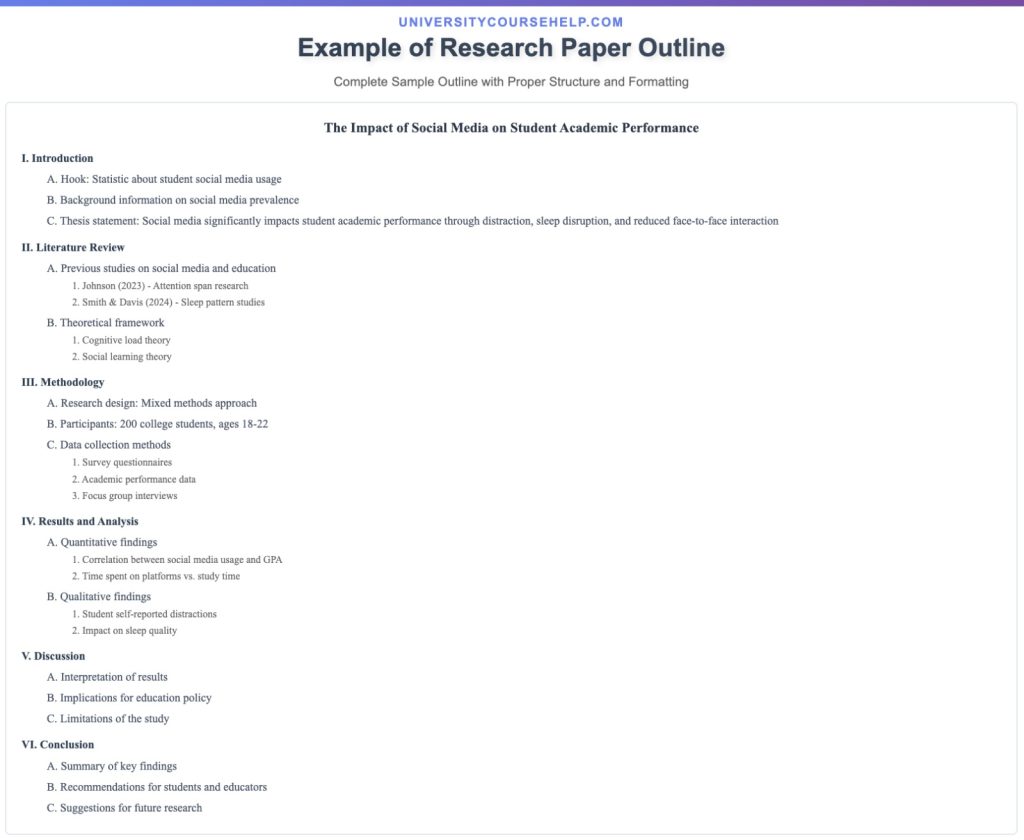
Writing a research paper requires careful planning, critical thinking, and organization. One of the most crucial steps in crafting a well-organized research paper is creating an outline. An outline serves as a roadmap for your paper, helping you structure your arguments, evidence, and ideas in a logical and coherent way. Whether you’re working on a college assignment or preparing for publishing, having a solid outline is the first step to success. In this blog post, we’ll explore different research paper outline formats, provide a research paper outline example, and offer helpful tips to organize your paper effectively.
What is a Research Paper Outline?
A research paper outline is a structured framework that organizes your ideas, arguments, and evidence in a logical order. It acts as a guide to writing your paper, helping you break down the main points you want to address and present them clearly. An outline typically includes the introduction, body sections, and conclusion, with key points and subpoints outlined underneath each section.
Outlines can vary in format depending on the style you prefer or the requirements set by your instructor. Whether you’re working with a full-sentence outline format or a more condensed version, the goal is to ensure that your research paper has a clear structure that guides the reader from the introduction to the conclusion.
Format: Different Types of Research Paper Outlines
There are several formats you can use when writing a research paper outline. The most common types are the alphanumeric outline, decimal outline, and full sentence outline format. Each format offers a different way of organizing information, and it’s important to choose the one that best fits your style or the formatting guidelines provided by your instructor.
1. Alphanumeric Outline
The alphanumeric outline is the most traditional and commonly used structure. It uses Roman numerals, capital letters, Arabic numerals, and lowercase letters to organize the main points and subpoints of your paper. Here’s a quick breakdown of the format:
- Roman numerals (I, II, III) for main sections.
- Capital letters (A, B, C) for subheadings.
- Arabic numerals (1, 2, 3) for more specific details under each subheading.
- Lowercase letters (a, b, c) for further details under each Arabic numeral.
Example of Alphanumeric Outline:
I. Introduction
A. Background information
B. Thesis statement
C. Purpose of the paper
II. Body Paragraph 1
A. Topic sentence
B. Supporting evidence
C. Analysis
III. Conclusion
A. Restate thesis
B. Summary of main points
C. Final thoughts
2. Decimal Outline
A decimal outline is similar to the alphanumeric outline, but it uses numbers in a decimal format to indicate levels of subordination. This type of outline is often preferred for academic papers because it clearly distinguishes the relationship between sections.
Example of Decimal Outline:
- Introduction
1.1 Background information
1.2 Thesis statement
1.3 Purpose of the paper - Body Paragraph 1
2.1 Topic sentence
2.2 Supporting evidence
2.3 Analysis - Conclusion
3.1 Restate thesis
3.2 Summary of main points
3.3 Final thoughts
3. Full Sentence Outline Format
A full sentence outline format is more detailed and uses complete sentences instead of phrases or keywords. This approach ensures that your outline reflects the structure of your essay and gives a more in-depth preview of your research paper. It’s especially helpful when you need to cite sources and organize your thoughts more thoroughly before writing the paper.
Example of Full Sentence Outline Format:
I. Introduction
- The rise of social media has dramatically impacted interpersonal communication.
- This paper will examine the positive and negative effects of social media on communication skills.
II. Body Paragraph 1
- One of the main benefits of social media is its ability to connect people across the globe, which has expanded communication channels.
- Studies show that social media allows for instant communication, enabling relationships to thrive despite physical distance.
III. Conclusion
- In conclusion, while social media has its drawbacks, its ability to enhance communication and maintain relationships outweighs the negative effects.
Need Help with Your Research Paper Outline?
Creating a solid research paper outline is the first step toward writing a successful paper. Whether you’re preparing for your PhD or working on a college assignment, UniversityCourseHelp.com offers example outlines to help you organize your ideas and structure your paper effectively.
Organize Your Paper with a Clear Structure
The key to writing a successful research paper is to organize your thoughts and ideas effectively. A well-organized outline will help you maintain focus and ensure that your paper flows logically from one point to the next. Here’s how you can break down the different sections:
1. Introduction
The introduction sets the stage for your paper. It should provide context for the topic, introduce the thesis statement, and explain the significance of the research. Start your outline by noting the main ideas you want to cover in the introduction, such as:
- The topic of your paper.
- The thesis or argument.
- A brief overview of your methodology or approach to the topic.
2. Body Paragraphs
The body of your paper should present your arguments and supporting evidence in a structured manner. This is where you will discuss your ideas in detail. Each body paragraph should focus on a single point that supports your thesis.
- Use subheadings to organize your body paragraphs.
- Be sure to cite your sources, especially when presenting data or research findings.
- Consider using examples from your research paper outline example to better illustrate your points.
3. Conclusion
The conclusion should briefly summarize the main points of your paper and reaffirm your thesis. In this section, you can also discuss the broader implications of your argument or suggest areas for further research.
- Restate the thesis in light of the evidence you’ve presented.
- Offer a final thought on the subject matter.
- Suggest the academic significance of your findings.
Example of a Research Paper Outline
Let’s take a look at a research paper outline example on the topic of social media’s impact on mental health:
I. Introduction
- Social media has transformed how we communicate and interact with others.
- Thesis: While social media has its benefits, it negatively impacts mental health by contributing to anxiety, depression, and low self-esteem.
II. Body Paragraph 1: Positive Effects of Social Media
- Social media provides a platform for individuals to connect with others globally.
- Studies show social media helps build relationships and support networks.
III. Body Paragraph 2: Negative Effects of Social Media
- Prolonged use of social media can increase feelings of isolation and anxiety.
- Research links social media use to depression and low self-esteem, particularly among adolescents.
IV. Conclusion
- While social media connects people, its negative effects on mental health cannot be overlooked.
- Further research should explore the ways to mitigate these effects and promote healthy social media use.
Research Paper Outline Example: A Clear Template for Your Paper
When you’re writing a research paper, having a research paper outline example can make the process significantly easier. This outline acts as a structured guide, helping you focus on the main points and organize them logically. Whether you’re working on an academic paper for class or preparing for publication, following a well-organized outline ensures that your paper flows logically from introduction to conclusion.
An example of an outline can also help clarify the structure you should follow. For instance, you might start with a thesis statement in the introduction, followed by sections for each major argument in the body, and end with a concluding section that summarizes your findings. Referencing an outline example helps ensure that your paper includes all the necessary components and that your arguments are well-supported.
How to Create an Outline: Tips, Ideas and Guidelines
Creating an outline for your research paper is a crucial step that guides your writing process. To write a research paper outline effectively, start by considering the structure of your paper. This means clearly identifying sections like the introduction, body, and conclusion, and organizing subheadings for each argument or point you wish to make.
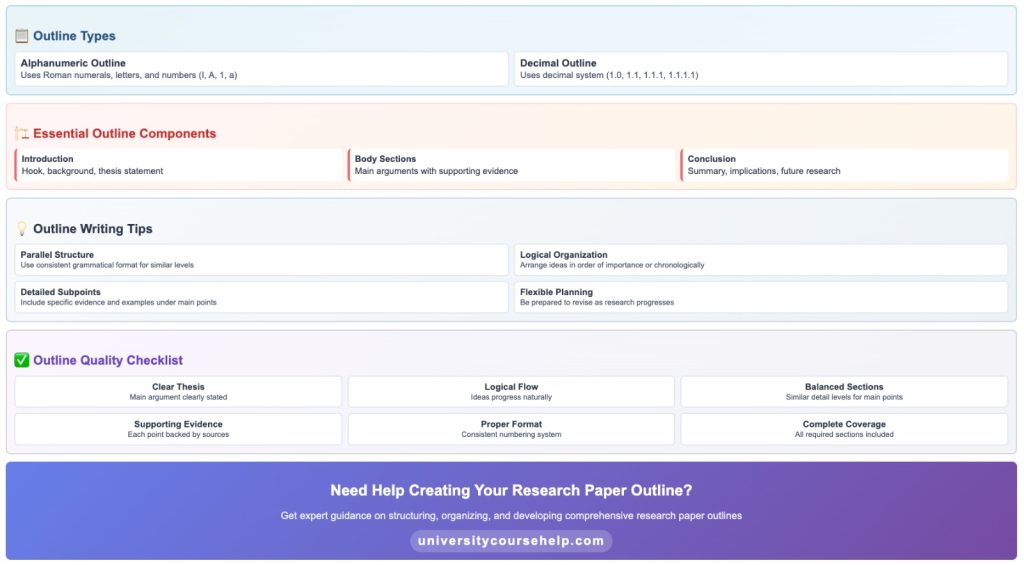
Having a clear outline will also help you stay focused, preventing writer’s block and making the process of writing your research paper easier. Each idea in your outline should be linked logically, ensuring that each paragraph or section follows naturally from the previous one. You can always use parenthesis to note further details or ideas that may be developed later.
Sample: A Real-Life Example of a Research Paper Outline
Looking at a sample research paper outline can help you understand how to organize your thoughts effectively. Samples allow you to see how to break down your paper into manageable sections, with clear and concise bullet points or numbered items that cover each major aspect of your research.
An outline sample can also give you a visual idea of what the finished product will look like, which can be especially helpful if you’re unsure about the structure or flow of your paper. For example, a sample outline might include:
- Introduction with the thesis statement.
- Sections of the body with subheadings for each argument.
- A conclusion that wraps up the paper and restates the thesis in light of the evidence provided.
Write a Research Paper Outline: Step-by-Step Guide
If you’re unsure how to write a research paper outline, following a step-by-step guide can help you approach the task in an organized manner. Begin by identifying your main topic and thesis. From there, break the topic into sections that can be addressed in the body of your paper.
For each section, note down the subheadings and supporting evidence that you plan to include. Think of your outline as a tool to help you organize your research and evidence in a way that will ultimately make writing the full paper easier. A good outline will also save time when you begin writing, as you’ll already have a clear plan in place.
How to Use a Table of Contents in Your Research Paper Outline
The table of contents is an essential part of any formal research paper. It provides readers with a roadmap, showing where each section of the paper can be found. If you’re working on a publication or an academic paper that requires professional formatting, including a table of contents at the beginning of your paper can enhance its organization.
In your research paper outline, the table of contents should list the headings and subheadings of each section, allowing the reader to easily navigate through your paper. This feature is particularly helpful when your paper spans multiple pages, ensuring that your reader can quickly find the section they’re interested in.
How a Writer Can Benefit from an Outline
As a writer, having an outline can help you streamline your writing process and stay organized. Outlines not only give structure to your research paper, but they also help in making decisions about the order of information, argument presentation, and supporting evidence.
With a well-organized outline, you can avoid feeling overwhelmed or stuck during the writing process, knowing exactly what your next point will be. It also serves as a roadmap to guide you through the writing, ensuring each paragraph and section logically builds on the previous one, making the task of publishing your paper much smoother.
Copy of the Research Paper Outline: How to Use It as a Reference
Once you’ve created an outline, you can copy it for easy reference during your writing. Having a physical or digital copy of your outline on hand allows you to stay focused, ensuring that all the essential sections are included and properly organized.
A copy of your outline can also help you during revision, ensuring that you haven’t missed any key points or arguments. If you’re following a full-sentence outline format, the copy will clearly show you what each section will look like in full form, which is particularly helpful when you’re ready to expand your ideas into full paragraphs.
Conclusion: Perfecting Your Research Paper Outline for Publishing
In publishing, structure is everything. By having a well-thought-out outline, you’ll be able to present your ideas clearly and effectively, supporting your arguments with credible evidence while adhering to the appropriate formatting guidelines. Whether you’re submitting your work for a college assignment or aiming for a professional publication, an outline helps you maintain focus, prevent writer’s block, and ensure that the final draft is cohesive and polished.
Need more help to write a research paper outline or want sample outlines to get started? UniversityCourseHelp.com is here to help you with every step of the process, from creating an outline to drafting and publishing your paper.
Download our research paper outline template and get started today!
How to Use a Research Paper Outline Template
To make the process of writing your research paper even easier, you can download a template or sample outline from UniversityCourseHelp.com. Using a template will help you follow the proper structure and ensure your paper adheres to the appropriate formatting guidelines.
By using a research paper outline template, you can easily input your main points, supporting evidence, and citations. This tool will help you stay on track, making it easier to prepare for writing the full paper.
Conclusion
Creating a clear and organized research paper outline is crucial to writing a successful paper. Whether you choose a full-sentence outline format, decimal outline, or alphanumeric outline, your goal should be to organize your ideas and structure your paper logically. By following the steps and using examples of research paper outlines, you can ensure that your writing process is smooth and efficient.
Need help creating an outline or want to download a template to get started? UniversityCourseHelp.com offers tools and resources to help you organize your ideas and structure your paper for success.
Start writing your research paper outline today! and take the first step toward writing a well-organized, compelling academic paper.
FAQs about Example of Research Paper Outlines: Best Research Guides
1. How Do You Write an Outline for a Research Paper?
Writing an outline for a research paper is an essential step in the writing process. It helps you organize your thoughts, structure your argument, and present your ideas logically to your reader. To begin, start with a research paper outline example that provides a general template you can follow. Here’s a step-by-step guide to create an outline:
- Title: Create a title for your research paper that reflects your topic.
- Introduction: Include a brief introduction to your paper. Present the thesis statement, the main argument or point you will prove throughout the paper.
- Body Paragraphs: Organize your body into subheadings that will discuss various aspects of your topic. Each subheading should represent a different point you want to cover.
- Conclusion: End with a conclusion that summarizes your findings and reinforces the thesis.
- Citations: Include references to sources and evidence that will support your argument, ensuring you have a structured and organized citation format.
By following this outline structure, you’ll have a clear direction for your research paper and be able to start writing with confidence. Create a research paper outline that helps you stay organized, ensuring each paragraph or section flows logically to the next.
2. What Are the Three Main Components of a Research Paper Outline?
The three main sections of a research paper outline include:
- Introduction: This section includes your thesis statement and a brief overview of the topic. You will present your argument or the significance of your research here.
- Body: The body of the outline contains subheadings and detailed points that will be explored in each paragraph. These include arguments, supporting evidence, and references to sources that back up your claims.
- Conclusion: The conclusion summarizes your findings and restates your thesis. It also provides a final thought or insight about the topic, reinforcing the academic significance of your argument.
3. What Are the 5 Steps to Writing an Outline?
Here’s a step-by-step guide for writing an outline for your research paper:
- Start with the topic: Begin by clearly stating your topic. This helps define the focus of your outline.
- Create a thesis statement: The thesis will drive the direction of your research and guide the rest of your outline. This is the argument that your paper will aim to prove.
- Organize into sections: Break your paper into the three main sections: Introduction, Body, and Conclusion.
- Develop subheadings: Under the body section, list the major points or arguments you will discuss, along with subheadings for further details. This structure helps organize your thought and presents the evidence clearly.
- Include supporting evidence: For each point in the body, include brief notes on how you will support your argument with citations and sources.
The goal of these steps is to create an outline that helps structure your research paper in an easy-to-follow format, making it easier to write.
4. What Is a Topic Outline and Example?
A topic outline is a simple outline format where the main points of your research paper are presented with brief phrases or keywords. It does not include full sentences but focuses on the structure and organization of your ideas.
Here’s an example of a topic outline for a paper on “The Impact of Social Media on Mental Health”:
- Introduction
- Definition of social media
- Importance of studying social media’s impact on mental health
- Main Argument
- Positive effects of social media on mental health
- Community support networks
- Negative effects of social media on mental health
- Increased anxiety and depression
- Positive effects of social media on mental health
- Counterarguments
- Social media as a tool for professional development
- The role of self-regulation in using social media
- Conclusion
- Restating the thesis
- Suggesting further research on social media and mental health
This format uses headings and subheadings to organize ideas into sections. Each section is represented by a brief phrase that outlines the content without delving into full sentences.
5. What Is the Difference Between a Decimal Outline and an Alphanumeric Outline?
A decimal outline is similar in format to the alphanumeric outline, but instead of Roman numerals or capital letters, it uses Arabic numerals to designate main points and subpoints. The decimal format makes it easier to adjust the structure if you need to add or remove sections.
Example of a decimal outline:
- Introduction
1.1 Thesis Statement
1.2 Background Information - Body
2.1 First Argument
2.2 Second Argument
2.2.1 Supporting evidence
2.2.2 Citations - Conclusion
3.1 Restate Thesis
3.2 Final Thoughts
The decimal outline allows for more flexibility and provides a clear structure to follow. It’s an excellent tool for organizing research papers that may require several revisions or changes in structure.
In conclusion, writing an outline is a critical part of the writing process that helps you structure your research paper logically. Whether you choose an alphanumeric, decimal, or topic outline, having a clear plan for your research and writing your paper will make the entire process much smoother. By creating an outline, you can stay organized, stay focused on your thesis, and ensure that each part of your paper is well-supported with evidence and citations.
If you need help creating outlines or want sample outlines to follow, UniversityCourseHelp.com is here to guide you through the entire process. Let us help you organize your ideas and create a well-structured research paper that meets academic requirements!

