

Cross-Sectional vs Longitudinal Research: Understanding the Key Differences
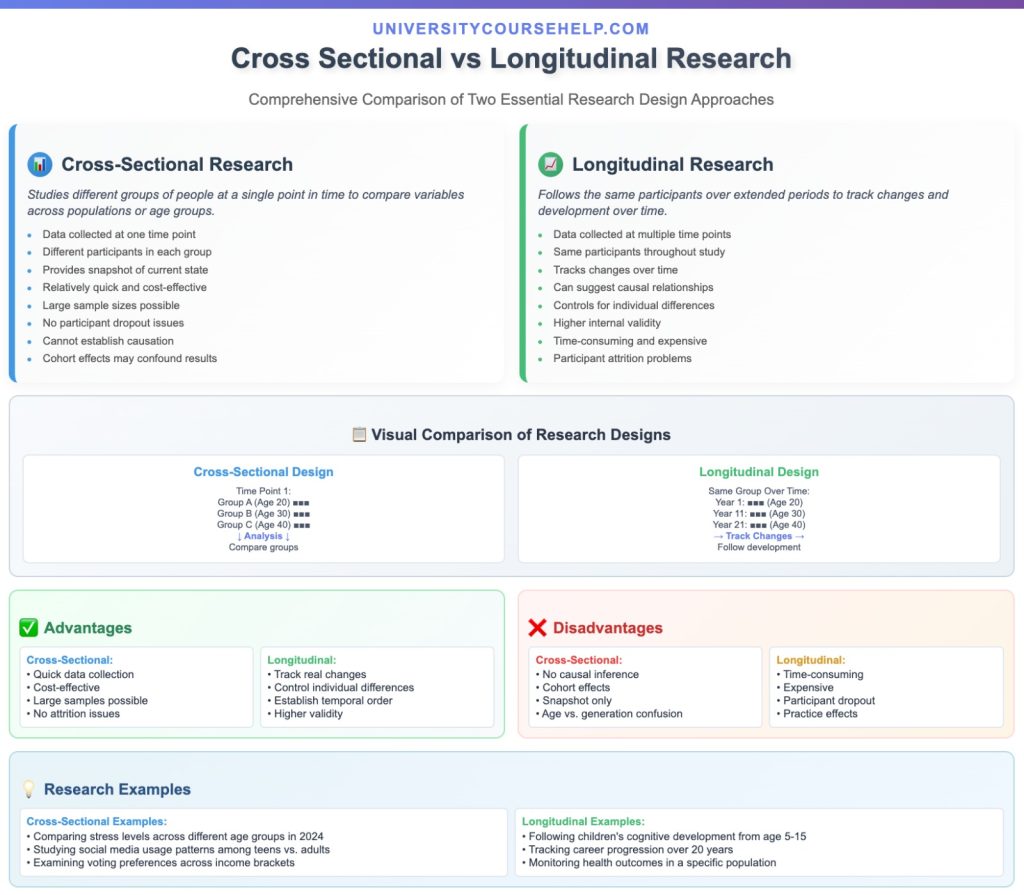
When conducting research, it is essential to choose the right research design to address your research question. Two common study designs in research are cross-sectional and longitudinal studies. Each has its strengths and weaknesses, depending on the purpose and goals of the research. In this blog post, we will explore the differences between cross-sectional and longitudinal research, define both approaches, and provide examples to help you understand when to use each type of study. Cross sectional vs longitudinal research: Cross sectional studies collect data at a single point in time. Longitudinal studies collect data from the same sample over time. The research question guides choice.
Cross-Sectional Study: A Snapshot of Data
A cross-sectional study is an observational study where data is collected at one point in time from a specific research / specific cohort or sample of people. This type of research design provides a snapshot of a population or a group at a single moment. It is commonly used in situations where researchers aim to test hypotheses about relationships between variables in a target population.
For example, a cross-sectional study could examine the relationship between physical activity and mental health in different age cohorts by collecting quantitative data from a sample of individuals across various age groups at one point in time. Cross-sectional analysis can highlight patterns or differences among groups, but it cannot establish causal relationships or observe changes over time.
Example of a Cross Sectional Study
Suppose researchers want to investigate the prevalence of smoking habits among teenagers in a specific city. A cross-sectional study would involve collecting data from a sample of teenagers at one point in time and analyzing quantitative data like the number of smokers versus non-smokers. The findings might show the current state of smoking habits in the population, but it will not provide information on how smoking habits evolve over time or the cause of smoking in teenagers.
Longitudinal Research: Tracking Changes Over Time
In contrast, longitudinal research involves studying the same cohort or group of participants over an extended period of time. This type of research is often used to study changes over time and track how specific variables evolve within the same group, helping researchers observe patterns and cause-and-effect relationships. Longitudinal cohort studies follow participants over multiple periods, collecting repeated measures to analyze data changes and the impact of variables.
Example of a Longitudinal Study Design
Consider a longitudinal cohort study tracking the long-term effects of exercise on heart health. Researchers could follow a group of individuals for several years, collecting qualitative data on their physical activity levels, diet, and health metrics like blood pressure. By analyzing longitudinal data, researchers could observe how exercise habits affect heart health over time and establish causal relationships between these variables.
Longitudinal studies are ideal for studying health outcomes, social behavior changes, or educational attainment over time, as they allow for data analysis on how individual or collective behavior evolves.
Cohorts in Cross-Sectional vs Longitudinal Cohort
In both cross-sectional and longitudinal studies, a cohort is a group of participants with shared characteristics or experiences. However, the way these cohorts are used differs:
- Cross-sectional studies typically involve a sample of people each time, creating distinct cohorts for each group based on factors like age, income, or geographic location. Each cohort is studied at a single point in time, and findings can be used to compare different groups within a population.
- Longitudinal studies track the same cohort over time, allowing for repeated measures and helping to identify how specific variables change over an extended period. This is particularly useful for research related to health outcomes or educational progress where long-term trends are important.
Panel Studies: A Hybrid of Cross-Sectional and Longitudinal Designs
Panel studies are a special type of longitudinal research where data is collected from the same sample of people at multiple points over time, but the analysis of longitudinal data can be applied in a way that looks at both individual changes and group-level trends. This type of study is useful in understanding how independent and dependent variables evolve over time within the same research participants.
For example, in a panel study investigating consumer behavior, researchers could gather data from the same group of participants at different intervals (e.g., yearly) to examine how their purchasing habits change. Panel studies combine the best aspects of both cross-sectional studies (by looking at different cohorts at various times) and longitudinal studies (by tracking the same participants), making them a powerful tool for secondary research.
Difference Between a Cross-Sectional Study and a Longitudinal Study
The difference between a cross-sectional study and a longitudinal study lies in their data collection process and study type:
- Cross-sectional studies collect data at a single point in time, typically from a sample of individuals or groups, to analyze a specific phenomenon or compare different cohorts. These studies often provide a snapshot of a population as a whole at that moment, and they are typically faster and cheaper to conduct.
- Longitudinal studies, on the other hand, involve data collection over an extended period, often from the same sample of individuals or research participants. These studies are designed to track changes over time, allowing for the observation of variables changing and helping researchers establish causal relationships. Longitudinal analysis can provide deeper insights into how independent and dependent variables interact over time, something that cross-sectional studies cannot establish.
Because cross-sectional studies do not track changes, they cannot measure cause-and-effect relationships. They are more useful for identifying correlations and patterns within a specific sample size at a given point. In contrast, longitudinal studies can observe how these relationships develop and evolve, offering more depth in the analysis of data over time.
Analysis of Longitudinal Data: A Deeper Look
Analysis of longitudinal data typically involves statistical analyses that examine how variables change over time within the same sample of research participants. Unlike in cross-sectional studies, where researchers compare data from different groups at a single time, longitudinal analysis looks at repeated measures from the same individuals or cohorts over several years.
This longitudinal analysis can uncover trends and patterns that would not be apparent in a cross-sectional study. For example, studying how education level affects income over several decades requires longitudinal data analysis, as this allows researchers to track changes in these variables and their interrelationships across time.
Additionally, research ethics must be considered carefully in longitudinal studies, as long-term data collection from the same participants can raise concerns about confidentiality, consent, and the long-term impact of the research on participants. Proper ethical standards must be maintained throughout the duration of the study.
Secondary Research and Longitudinal Data
In the context of secondary research, longitudinal data is valuable because it provides historical insights into trends and changes over time. Researchers can use existing longitudinal cohort studies or panel studies to analyze data from the same sample without having to collect new data. This can be particularly useful when examining public health trends, economic shifts, or social behavior patterns over decades.
For example, in medical research, researchers may use longitudinal data to study the long-term effects of a specific drug on a patient cohort. By analyzing historical data, researchers can compare pre-existing data with current findings to observe how variables change over an extended period, helping inform new hypotheses or refine research designs.
The Importance of Sample Size in Cross-Sectional and Longitudinal Studies
Both cross-sectional studies and longitudinal studies rely on sample size to ensure that the findings are statistically significant and representative of the target population. However, the sample size requirements differ between the two:
- In a cross-sectional study, researchers typically need a larger sample size to ensure the data is representative of the population as a whole. This is because cross-sectional research involves gathering data from different individuals at a single point in time and comparing these groups.
- In a longitudinal study, the sample size can be smaller initially, but it must be maintained over the long term to ensure accurate comparisons over time. Attrition, or the loss of research participants, is a common challenge in longitudinal studies, as people may drop out or move away, affecting the overall data collection process.
Conclusion: Choosing the Right Study Type for Your Research
Choosing between a cross-sectional and a longitudinal study depends on the research question and the type of data needed. If you’re looking to capture a snapshot of a target population at a single moment in time, then a cross-sectional study may be ideal. However, if you want to study changes over time and establish cause-and-effect relationships, a longitudinal study is more appropriate.
Both study types have their strengths and weaknesses, and researchers should carefully consider their research design, target population, and available resources when selecting between a cross-sectional or longitudinal study. Longitudinal designs allow for deeper insights into the dynamics of change, while cross-sectional studies are effective for quickly comparing different groups at a specific moment.
Learn More About Study Designs and Which One Works Best for Your Research!
Statistical Analyses: Comparing Cross-Sectional and Longitudinal Data
When it comes to data analysis, the approach differs significantly between cross-sectional and longitudinal research:
- Cross-sectional studies typically involve statistical analyses like descriptive statistics, which summarize the characteristics of the population at a specific point in time. For example, researchers may analyze the mean or median of a variable (e.g., average income or health metrics) across different cohorts or groups.
- Longitudinal research often requires more advanced statistical analyses, such as repeated measures analysis or longitudinal data analysis, to study how variables change over time within the same participants. These analyses can help determine whether certain interventions or factors lead to changes in the independent variables over time.
Cross-Sectional and Longitudinal Studies: What’s the Difference?

The difference between longitudinal and cross-sectional studies can be summarized in the following key aspects:
- Timeframe:
- Cross-sectional studies collect data at a single point in time.
- Longitudinal studies involve data collection over an extended period.
- Purpose:
- Cross-sectional studies are useful for testing hypotheses and observing trends at a specific moment in time.
- Longitudinal studies are designed to study change over time and establish causal relationships.
- Analysis:
- Cross-sectional studies offer a snapshot of the population at one point in time, whereas longitudinal studies involve data collection over multiple points to analyze patterns of change.
- Data Collection:
- In cross-sectional research, the study collects data from different cohorts at one time, while in longitudinal research, the same sample of people is tracked and measured over time.
Prospective vs Retrospective Studies: A Further Exploration
Prospective studies are a type of longitudinal design where researchers follow participants forward in time to observe how certain variables influence future outcomes. For example, in medical research, a prospective cohort study might follow a group of individuals to see how their lifestyle choices (e.g., physical activity) affect heart disease over a span of decades.
In contrast, retrospective studies examine past data, looking at existing records or memories of previous events. While these studies are quicker and less costly than prospective studies, they are more susceptible to biases and data inaccuracies.
Conclusion: Choosing the Right Research Design
Both cross-sectional studies and longitudinal research play important roles in the research process. The choice between the two depends on the research question and the type of data analysis required.
- Cross-sectional studies provide valuable insights into how different groups or cohorts behave at a specific moment in time, making them ideal for understanding prevalence or correlations.
- Longitudinal research, on the other hand, is essential for understanding how variables change over time and establishing cause-and-effect relationships.
Choosing the appropriate study design is vital for achieving reliable, meaningful results. Researchers must consider the target population, available resources, and the research question at hand when deciding between these two types of studies.
Start Learning More About Research Designs! and discover which approach is best for your research project today!
FAQs about Cross Sectional Vs Longitudinal Research | Longitudinal Studies
1. What is the Difference Between Cross-Sectional Research and Longitudinal Research?
The main difference between longitudinal and cross-sectional data sets lies in the study design and the way data is collected over time.
- Cross-sectional studies collect data at one point in time, meaning they assess variables at a single point or over a single period. This type of research is often used to observe the relationship between different groups or characteristics at that moment in time. For example, a cross-sectional study might examine the physical activity levels of different age cohorts to understand how activity differs among them at one specific moment.
- In contrast, longitudinal studies involve data collection over an extended period of time. These studies track changes in variables over time and are typically used to observe how certain factors evolve or how they affect cause-and-effect relationships. For example, longitudinal cohort studies might examine the impact of physical activity on health by following the same study participants over several years, monitoring changes in their health outcomes.
Longitudinal research allows researchers to study changes over time, while cross-sectional research provides a snapshot of data at a specific moment.
2. What is an Example of a Cross-Sectional Study?
An example of a cross-sectional study could be a survey that examines the educational attainment of different age cohorts at one point in time. For instance, a researcher might collect data from people in three different age groups (e.g., 18-30, 31-45, and 46-60) to explore how educational levels differ across these cohorts.
In this study design, the researcher doesn’t track the same study participants over time; rather, they collect data at a single point in time from each group. This approach helps answer questions like, “What is the educational level of individuals at different ages?” but does not allow for analyzing changes over time or establishing cause-and-effect relationships.
3. What is One Advantage of a Cross-Sectional Study Over a Longitudinal Study?
One major advantage of a cross-sectional study over a longitudinal study is that it is faster and less resource-intensive. Since cross-sectional studies involve collecting data at one point in time, they do not require the researcher to track participants over an extended period of time, as in longitudinal research. This makes cross-sectional studies much quicker to complete and allows researchers to gather data from a fresh sample of people or new cohorts each time.
Additionally, cross-sectional studies can provide a broad overview of variables at a single point in time, making them useful for examining the distribution of traits or the prevalence of certain behaviors across different populations or cohorts. This is particularly valuable when researchers are limited by available resources and time, as they can get valuable insights without the need for extended data collection or attrition (i.e., participants dropping out over time).
4. What is the Main Difference Between a Longitudinal and a Cross-Sectional Data Set?
The main difference between longitudinal and cross-sectional data sets lies in the study design and the data collection process:
- Cross-sectional data refers to data collected at a single point in time. It allows researchers to compare different groups or cohorts within a population at one moment in time, but it does not provide insight into how variables change over time.
- Longitudinal data involves data collection over an extended period, often from the same sample of people or study participants. This type of research helps researchers observe changes in variables and is especially useful for tracking the development or change over time, such as monitoring how physical activity affects health over several years.
Both research methods are valuable, but longitudinal data can help establish causality and observe patterns over time, while cross-sectional data gives a snapshot of a specific time period, useful for exploring associations but not for causal relationships.

