

Validity in Research: Understanding Its Importance and Types
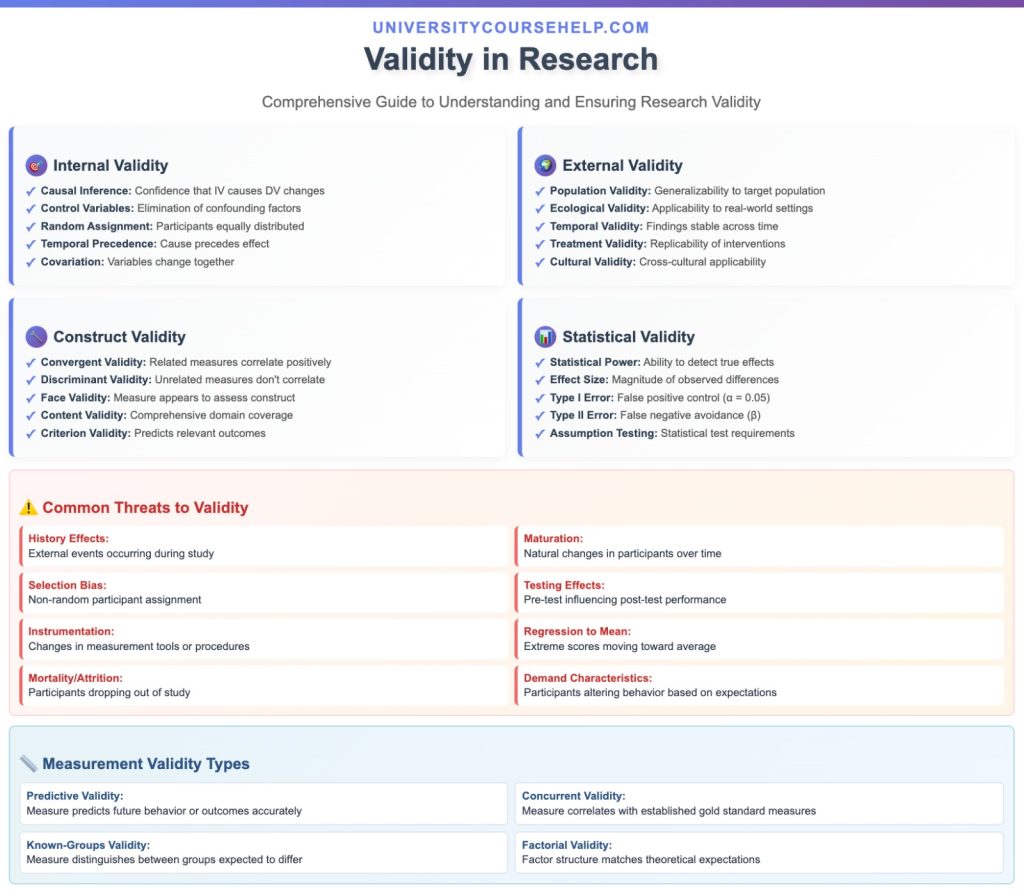
When conducting research, the quality and accuracy of the study’s results are paramount. To ensure that the findings are credible and reflect the true nature of the research question, it’s essential to understand validity. In this blog post, we will define validity in research, explore its various types, and provide examples to help clarify the significance of validity in the research process.
What is Validity in Research?
Validity refers to the extent to which a study accurately measures what it is intended to measure. It is a critical aspect of research methodology because it assesses how well the research design, tools, and data collection methods align with the research objectives. Simply put, validity ensures that the research outcomes are true and not the result of flaws in the study’s methodology.
There are various types of validity used in research, including internal validity, external validity, content validity, and construct validity. Each of these focuses on a different aspect of the research process, ensuring that the study accurately reflects the concepts it is designed to measure.
Author: Scott Bates and His Contribution to Understanding Validity
One of the key contributors to understanding validity in research is Scott Bates, who, along with Paul C. Cozby, co-authored the textbook “Methods in Behavioral Research”. This book provides in-depth insights into validity and reliability, offering students a clear framework for understanding how to ensure validity in their own research.
Through the textbook, Scott Bates explains how different validity types apply to both qualitative and quantitative research. The textbook drives home foundational concepts, such as how internal and external validity impact the accuracy of a measure and how to avoid low reliability in your study.
Textbook: “Methods in Behavioral Research” and Validity
In “Methods in Behavioral Research”, Scott Bates and Paul C. Cozby delve into the complexities of research validity. The textbook provides a detailed explanation of how to approach methodology in research, focusing on the importance of validity at every stage of the study. The table of contents of the textbook outlines key sections that help students understand how to measure the accuracy of their research findings and evaluate the validity of the study.
For example, the book discusses internal validity, which refers to whether the research accurately reflects causal relationships between variables. It also explains external validity, which assesses whether the study’s findings can be generalized to different populations or settings.
Overview: The Importance of Validity in Research
Validity is vital because it directly influences the quality of the research results. High validity means that the study measures what it is intended to measure, leading to reliable and credible results. Without validity, the conclusions drawn from a study may be inaccurate, potentially skewing the results and leading to misleading outcomes.
In any research—whether you’re working on a quantitative study or qualitative research—ensuring validity is crucial for maintaining the integrity of your research. Whether you’re using experimental designs or conducting a survey, understanding and ensuring validity helps researchers make accurate conclusions about their findings.
Detail: Types of Validity in Research
There are several types of validity that researchers must consider when designing their studies. Understanding each of them is essential for ensuring that your research is accurate and reflects the real-world phenomena you aim to measure.
1. Internal Validity
Internal validity refers to the degree to which the results of the study can be attributed to the manipulation of the independent variable and not to other external factors. In simple terms, it assesses whether the research design accurately reflects cause-and-effect relationships. High internal validity means that the study results are likely due to the variables being studied and not confounding factors.
2. External Validity
External validity refers to the degree to which the study results can be generalized to other settings, populations, or times. For example, a study conducted on a small group of people may not have high external validity if the results cannot be applied to a larger population. Understanding external validity ensures that your research can have broader implications beyond the immediate study.
3. Content Validity
Content validity ensures that the measurement tool (e.g., survey, test, interview) adequately covers all aspects of the concept it is intended to measure. For example, if you create a survey to measure job satisfaction, content validity ensures that the survey covers all important aspects of job satisfaction (salary, work environment, work-life balance, etc.) and not just one component.
4. Construct Validity
Construct validity refers to the extent to which the test or measurement tool actually measures the concept it is intended to measure. For example, a test designed to measure intelligence should not measure other factors like memory or attention. Ensuring construct validity guarantees that the research methodology and measurement tools are aligned with the study’s intended purpose.
5. Face Validity
Face validity refers to the degree to which a measure seems to measure what it is supposed to measure at first glance. Although not as rigorous as other forms of validity, face validity provides an initial assessment of whether a research instrument appears valid to both researchers and participants.
Review: Assessing the Validity of Research
To ensure validity in your research, it is essential to review the study design and methodology carefully. Look at each element of the study—measurement tools, variables, data collection methods, and analysis techniques—and assess whether they align with the research question.
You can assess the validity of research findings by considering factors like reliability and the significance of validity in research. By comparing different types of validity and determining their strengths, you can ensure that your study is valid and yields reliable results.
University: Learning About Validity in Research
Universities like Utah State University and the University of California provide comprehensive courses and resources on validity in research. These institutions offer textbooks like “Methods in Behavioral Research”, which support students in learning how to incorporate validity into their own research designs.
University courses on behavioral research guide students through the process of assessing internal and external validity, ensuring that students understand the importance of validity when it comes to research outcomes. Professors at these universities also emphasize how to measure the validity of research studies and ensure that research results are accurate and reliable.
Reliability vs Validity: Understanding the Difference
Reliability vs validity is a common discussion point in research methodology. Both concepts are essential in determining the quality and credibility of a study, but they refer to different aspects of the research process.
- Reliability refers to the consistency of a measure—whether the same result can be achieved when the research is repeated under the same conditions. For example, test-retest reliability ensures that the same research method produces the same results over time.
- Validity, on the other hand, refers to the accuracy of a study. Does the study measure what it claims to measure? Validity in science ensures that the research findings are true and not due to flaws in the study’s methodology. In short, while reliability ensures consistency, validity ensures accuracy.
To improve your research quality, both reliability and validity need to be high. However, research reliable doesn’t always mean it’s valid, and validity without reliability diminishes the credibility of a study.
Criterion Validity: Evaluating How Well a Measure Predicts Outcomes
Criterion validity evaluates how well a measurement or test predicts an outcome based on a known criterion. It’s divided into two types:
- Concurrent validity: This type of criterion-related validity examines how well a test’s results correlate with another established measure at the same time.
- Predictive validity: This evaluates how well a test predicts future outcomes.
For example, if you create a survey to measure job satisfaction, criterion validity ensures that the test designed to measure job satisfaction accurately predicts the actual satisfaction level of employees. High criterion validity ensures that the study measures what it is intended to measure, providing credible research.
Research Method: Choosing the Right Method to Ensure Validity and Reliability
The research method chosen for your study plays a significant role in determining the validity and reliability of your findings. Different types of research—such as quantitative or qualitative research—require distinct methods and tools to ensure that the study results are accurate and consistent.
For example, quantitative validity focuses on measuring variables in a structured and statistically measurable way. Qualitative research, on the other hand, may rely on inter-rater reliability, ensuring that different researchers observe and interpret the data in the same way.
Choosing the right research methodology for your study is key to ensuring both internal consistency and high reliability, which ultimately leads to more trustworthy research outcomes.
Ready to Ensure Validity in Your Research?
Make your research stronger, more reliable, and scientifically sound by mastering validity! Whether you’re designing an experiment, conducting surveys, or analyzing data, UniversityCourseHelp.com has the resources to guide you through the concepts of reliability and validity.
Validity and Reliability: How They Work Together
Validity and reliability are closely related but distinct concepts. While reliability ensures that a study’s measurements are consistent, validity assesses whether the study actually measures what it claims to measure. Both are essential for credible research, but they serve different purposes in the research process.
- Reliability is a prerequisite for validity—without consistency, there cannot be accuracy. For instance, if an instrument is not reliable (i.e., it produces inconsistent results), then it cannot be valid either.
- Validity, however, cannot be ensured without reliability. Validity refers to the accuracy of the results, ensuring that the study accurately measures the intended variables, and not some unrelated factors.
By maintaining both high reliability and validity, you can improve the overall quality of research and ensure that your research method produces meaningful, consistent results.
Research Validity: Ensuring the Accuracy of Your Study
Research validity is essential to ensure that your study accurately reflects the research question and provides reliable results. Researchers must assess internal validity, which looks at the degree to which a study’s design allows for valid conclusions about cause and effect, and external validity, which determines the extent to which the study can be generalized to other settings or populations.
For example, an experiment conducted in a controlled setting may have high internal validity, but the results may not be applicable to real-world situations, which would limit its external validity. Understanding and balancing both types of validity is key to conducting comprehensive, credible research.
Research Study: How to Assess Validity in Your Study
When conducting a research study, assessing validity involves checking whether the study measures what it is intended to measure and whether the results can be trusted. Different types of validity are important for different types of research.
- Face validity refers to whether a test or measure appears to measure what it’s supposed to at first glance. While it doesn’t ensure the accuracy of results, it serves as a good first step in evaluating the test’s overall credibility.
- Ecological validity measures how applicable your study’s results are to real-world settings. For instance, a study that takes place in a lab setting may lack ecological validity if the results can’t be generalized to everyday scenarios.
Ensuring high validity and reliability in your research study requires carefully selecting and designing the right methodology, taking into account factors like internal validity and content validity.
Conclusion Validity: Closing the Loop on Your Research Findings
Conclusion validity refers to the extent to which the study results support the conclusions drawn from the data. Ensuring high conclusion validity means that the study’s data is analyzed and interpreted in a way that accurately reflects the research question.
By using appropriate statistical methods, such as test-retest reliability or inter-rater reliability, you can increase the reliability of the study results and improve conclusion validity. This ensures that the study’s findings are not only consistent but also accurately measure the intended concepts.
Internal Validity Definition: Ensuring Causal Relationships Are Accurate
Internal validity refers to the **degree to which a study accurately measures the relationship between the independent and dependent variables, and whether this relationship is causal. In simpler terms, it assesses how well the research design allows you to measure the same thing consistently and accurately within the context of the study.
For example, in an experiment where you manipulate one variable to see its effect on another, internal validity ensures that the changes in the dependent variable are solely due to the manipulation of the independent variable and not some other uncontrolled factor. This is essential for confirming causal relationships and for ensuring the research results are meaningful.
Validity Definition in Science: The Core of Accurate Research
In science, validity is critical as it ensures that the research methodology and findings measure what they are intended to measure. The validity definition in science refers to the accuracy and credibility of the study’s outcomes. For instance, when conducting a survey, validity means that the questions are designed to measure the intended constructs and not something unrelated.
Understanding validity in science helps researchers assess whether their conclusions reflect true relationships in the real world. It establishes whether the study’s measurements truly capture the phenomena they set out to study, ensuring that the data collected is both relevant and reliable.
Validity and Reliability: How They Work Together
Validity and reliability are interconnected but distinct concepts. Reliability refers to the consistency of a measure across time and different situations, while validity refers to the accuracy of the measure. Both are required for a study to yield meaningful and credible research.
For example, if a survey produces consistent results (i.e., high reliability) but does not actually measure what it’s supposed to (i.e., low validity), then the results are still problematic. High reliability ensures that the consistency of a measure is maintained, but without validity, the research cannot be trusted as accurate.
Concepts of Reliability and Validity: A Unified Approach
When conducting research, understanding the concepts of reliability and validity is essential for evaluating the overall quality of research. Reliability ensures that a study is consistent and replicable, while validity guarantees that the research outcomes reflect the true relationships between variables. Without validity, even the most reliable research results cannot be trusted.
For example, a research method with high internal consistency (a form of reliability) can show consistent results, but without validity, it cannot provide meaningful insights into the phenomenon being studied. These two concepts must work in tandem to produce high-quality, credible research.
Establish Construct Validity: Measuring What You Intend to Measure
Construct validity is one of the most important forms of validity. It assesses whether a research tool, such as a test or survey, actually measures the construct it is intended to measure. For example, a survey designed to measure job satisfaction should not inadvertently measure employee engagement or motivation unless those factors are part of the defined construct of job satisfaction.
By establishing construct validity, researchers ensure that the study accurately reflects the concepts they aim to study, making the research more credible and relevant. It’s a fundamental aspect of research validity, and without it, the study results may be flawed or misleading.
Degree to Which a Study Measures What It Is Intended to Measure
The degree to which a study measures what it is intended to measure is directly related to the validity of the research. For example, in a survey designed to assess customer satisfaction, if the questions do not align with the core aspects of customer satisfaction, then the study has low validity. Ensuring that the research design is structured in a way that measures the intended variables accurately is essential for achieving high validity.
Main Types of Validity: Key Forms in Research
There are four types of validity that researchers must consider when designing their studies:
- Internal Validity: The extent to which the research findings can be attributed to the manipulation of the independent variable, rather than other confounding factors.
- External Validity: The degree to which the study’s findings can be generalized to other settings, people, or times.
- Construct Validity: Ensures that the research tools accurately measure the concept they are intended to measure.
- Content Validity: Ensures that the study covers all relevant aspects of the concept being measured, leaving no key areas overlooked.
Each of these main types of validity is essential in ensuring that research is both reliable and accurate.
Research Means: Achieving Validity Through Proper Methodology
The research means refers to the methods and tools researchers use to conduct their studies. Achieving validity requires selecting the right research methods and measurement tools that will accurately reflect the study’s goals.
For instance, in quantitative research, the research design must be tailored to ensure internal validity (by controlling for confounding variables) and external validity (by selecting a representative sample). In qualitative research, content validity and construct validity are crucial to ensure that the findings are reflective of the intended phenomena.
Research Often Uses Multiple Validity Types
In research, validity is not a one-size-fits-all concept. Research often requires combining different validity types to create a comprehensive and accurate study. For example, a survey might require content validity (ensuring the questions cover all aspects of the topic) and criterion validity (ensuring the survey results align with an established measure).
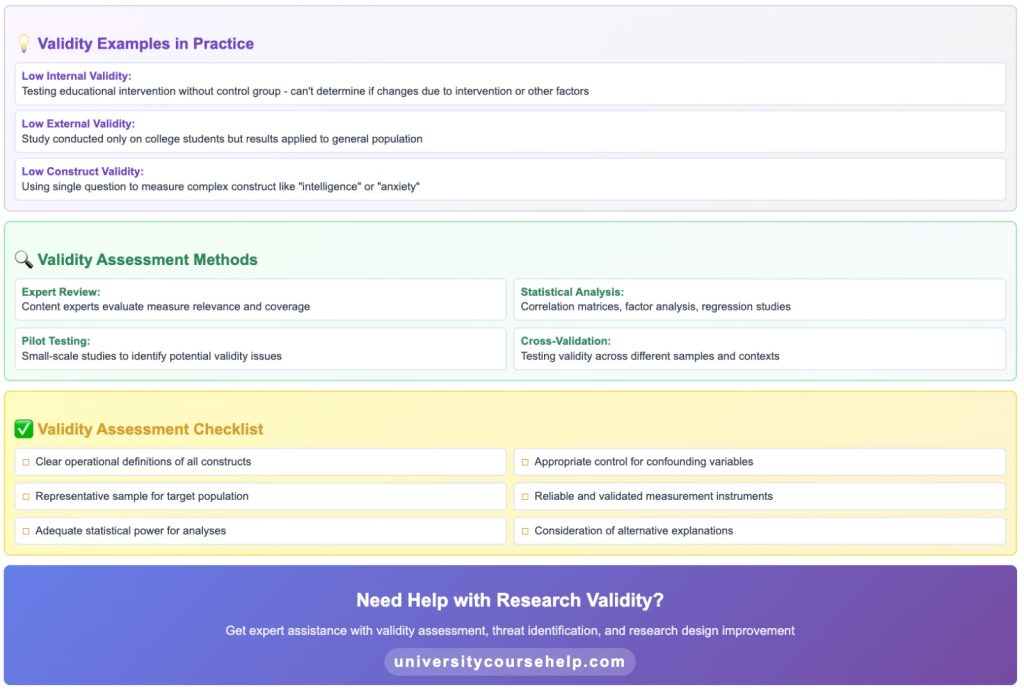
By using multiple validity types, researchers can enhance the accuracy and credibility of their findings, making the study more meaningful and applicable.
Validity Is Whether the Results Truly Measure What They Are Intended To
At its core, validity is whether the results of a study accurately measure what the research is intended to measure. Whether you’re conducting an experiment, a survey, or an observational study, ensuring validity means ensuring that the measurements, tools, and methods align with the study’s objectives.
By understanding these concepts, such as internal validity definition, construct validity, and criterion-related validity, researchers can design studies that not only yield reliable results but also accurately represent the phenomena they are investigating. Validity is a cornerstone of any research study, ensuring that the findings are trustworthy and scientifically meaningful.
Criterion-Related Validity: Evaluating the Predictive Power of Your Research
Criterion-related validity evaluates how well the research outcomes align with established benchmarks or external measures. This includes predictive validity, where the study predicts future behaviors or outcomes, and concurrent validity, where the study is compared with other established measures at the same time.
For example, if a survey is intended to measure employee performance, criterion-related validity assesses how well the survey’s results correlate with actual job performance, making sure that the research findings are grounded in real-world application.
Improve Research: How Validity and Reliability Drive Better Results
To improve research, it’s crucial to ensure that both validity and reliability are considered during the design phase. Ensuring internal validity through controlled experiments and considering external validity when generalizing your findings to different populations helps create credible research. Moreover, integrating reliability through consistent measurement tools, such as test-retest reliability, guarantees that the study results are dependable over time.
By paying attention to both validity and reliability, researchers can improve research quality and ensure that research findings are robust, accurate, and reflective of real-world scenarios.
Types of Research: Validity Considerations Across Different Research Designs
The concept of validity applies across various types of research, whether you’re conducting qualitative research or quantitative research. In quantitative studies, you might focus more on construct validity and criterion validity, whereas qualitative research might place greater emphasis on face validity and content validity.
Each research design has different requirements for validity and reliability, and understanding the types of research you’re conducting helps guide your approach to ensuring the accuracy and consistency of your results.
By integrating these validity types and understanding how reliability and validity work together, researchers can improve the quality of research and ensure their studies produce meaningful, trustworthy results. Whether you’re working on a research paper or conducting field studies, ensuring validity is key to achieving credible outcomes.
Item: Tools for Ensuring Validity in Research
To ensure validity, researchers rely on various items like questionnaires, tests, and measurement scales. These tools help assess different aspects of validity, such as content validity and construct validity.
For example, when creating a survey to measure customer satisfaction, you might include questions that assess different facets of satisfaction, such as product quality, customer service, and value for money. By ensuring the survey items accurately reflect the key concepts of interest, researchers can achieve content validity.
Paper: Writing a Research Paper with High Validity
When writing a research paper, validity should be at the forefront of your analysis and reporting. To ensure research validity, carefully outline how you will measure your variables, the research method used, and how you plan to analyze the data. Additionally, be transparent about any limitations regarding internal or external validity and how they may affect your research findings.
This careful attention to validity not only improves the quality of research but also ensures that your study results are reliable and meaningful.
By understanding the different types of validity, assessing the quality of research, and ensuring that your study is both reliable and valid, you can produce research that stands up to scrutiny and provides valuable insights. Whether you are conducting qualitative research or quantitative research, validity is a cornerstone of any solid study.
FAQs about Reliability and Validity in Research: Types of Validity in Research
1. What is Meant by Validity in Research?
Validity in research refers to the extent to which the results of a study truly measure what they are intended to measure. It is a fundamental concept in research methodology that evaluates the quality of research and its ability to accurately answer the research question. In simpler terms, validity ensures that the research findings are credible and that the study measures the concepts or variables it aims to.
There are different types of validity such as internal validity, which refers to whether the research design accurately identifies causal relationships, and external validity, which addresses whether the study results can be generalized to other settings or populations.
2. What is Reliability and Validity?
Reliability and validity are both critical concepts in research. Reliability refers to the consistency or stability of a measurement across time or situations. It ensures that the research findings are reproducible, meaning that a reliable research method will yield similar results if repeated under the same conditions. For example, if you measure a behavior in a study multiple times, a reliable measure will produce consistent results.
On the other hand, validity evaluates the accuracy of what is being measured. In other words, validity ensures that a research study measures what it is supposed to measure and not something else. The concept of validity applies to the accuracy of both quantitative research and qualitative research, ensuring that the study results are true representations of the real-world phenomenon being studied.
3. What is an Example of Validity?
An example of validity can be seen in a survey designed to measure customer satisfaction. If the survey is meant to measure customer happiness, but it asks questions unrelated to this, like personal preferences unrelated to service quality, then the survey lacks content validity. This means that the survey does not measure the intended concept accurately, and the validity of the study would be questioned.
A specific example of validity is construct validity, which refers to the extent to which a test measures the concept it is intended to measure. For example, if you’re developing a test to measure math skills, construct validity ensures that the test truly assesses math ability, not other factors like reading comprehension or test-taking skills.
Another example is criterion validity, which evaluates how well one measure predicts an outcome based on a criterion, like predictive validity in an educational assessment where a student’s performance on a test predicts their future academic success.
4. How Can You Check the Validity of Research?
To check the validity of research, you need to examine several key aspects, including:
- Internal Validity: Check if the study accurately measures the variables intended by the research design. For example, in experimental research, internal validity ensures that the results are not influenced by extraneous factors or biases. The study should be well-controlled, and the results should be caused by the manipulated variables, not other factors.
- External Validity: Evaluate whether the study results can be generalized to other settings, populations, or situations. This is especially important in consumer research or field studies, where the research setting may differ from the real-world application.
- Content Validity: Review if the measurement tool (such as a survey or test) fully covers the subject or behavior it intends to measure. For example, a survey designed to measure job satisfaction should include items related to all aspects of job satisfaction, including work environment, salary, and job role.
- Construct Validity: Ensure that the study is measuring the intended construct. For example, if a test is designed to measure intelligence, check whether it truly assesses intelligence rather than other unrelated factors like memory or problem-solving.
- Statistical Methods: Using statistical methods such as concurrent validity or convergent validity, researchers can test the degree to which the results align with other established measures or similar studies.

