

Argumentative Research Essay Topics: A Guide to Finding the Perfect Topic

Writing an argumentative research essay can be both challenging and rewarding. It involves taking a clear stance on a specific issue, presenting compelling evidence, and addressing counterarguments. Choosing the right topic is crucial, as it sets the foundation for the entire essay. In this post, we’ll explore argumentative research essay topics, offer helpful tips for selecting a good topic, and provide examples that you can use in your next essay.
What Is a Good Argumentative Essay?
A good argumentative essay clearly presents an argument on a controversial issue, backed by well-researched evidence. It persuades the reader to consider your perspective, all while addressing opposing viewpoints. The goal is to showcase strong reasoning and support, helping readers understand why your argument holds merit.
Key characteristics of a good argumentative essay include:
- A clear thesis statement that sets the direction of the essay.
- Well-organized body paragraphs that focus on one point each.
- Strong supporting evidence and credible sources.
- A thorough analysis of the counterarguments and refutation of those opposing views.
- A conclusion that ties everything together and reinforces the main argument.
The Importance of Choosing Strong Argumentative Essay Topics
Choosing strong argumentative essay topics is essential to crafting a compelling essay. The topic sets the tone for your argumentative writing and influences the direction of your research. A well-chosen topic should be controversial, with two sides that allow for debate and exploration. The brainstorming process is crucial here, as it helps you narrow down your options to the strongest, most engaging topic.
How to Choose the Right Argumentative Essay Topic
When deciding on an argument essay topic, you should consider several factors:
- Relevance: The topic should be relevant to your audience and current events, allowing you to engage with the latest discussions.
- Personal interest: Select a subject that interests you and aligns with your beliefs, as it will make the writing process more enjoyable and authentic.
- Debatability: Choose a controversial issue that has at least two opposing perspectives, ensuring you can present and support your argument effectively.
- Research availability: Make sure that there are enough credible sources to support your argument and counterarguments.
Some topics may be too broad or obscure, while others may not provide enough material to build a solid argument. Finding the right topic ensures that your argument essay is both thorough and persuasive.
Strong Argumentative Essay Topics: Examples and Ideas
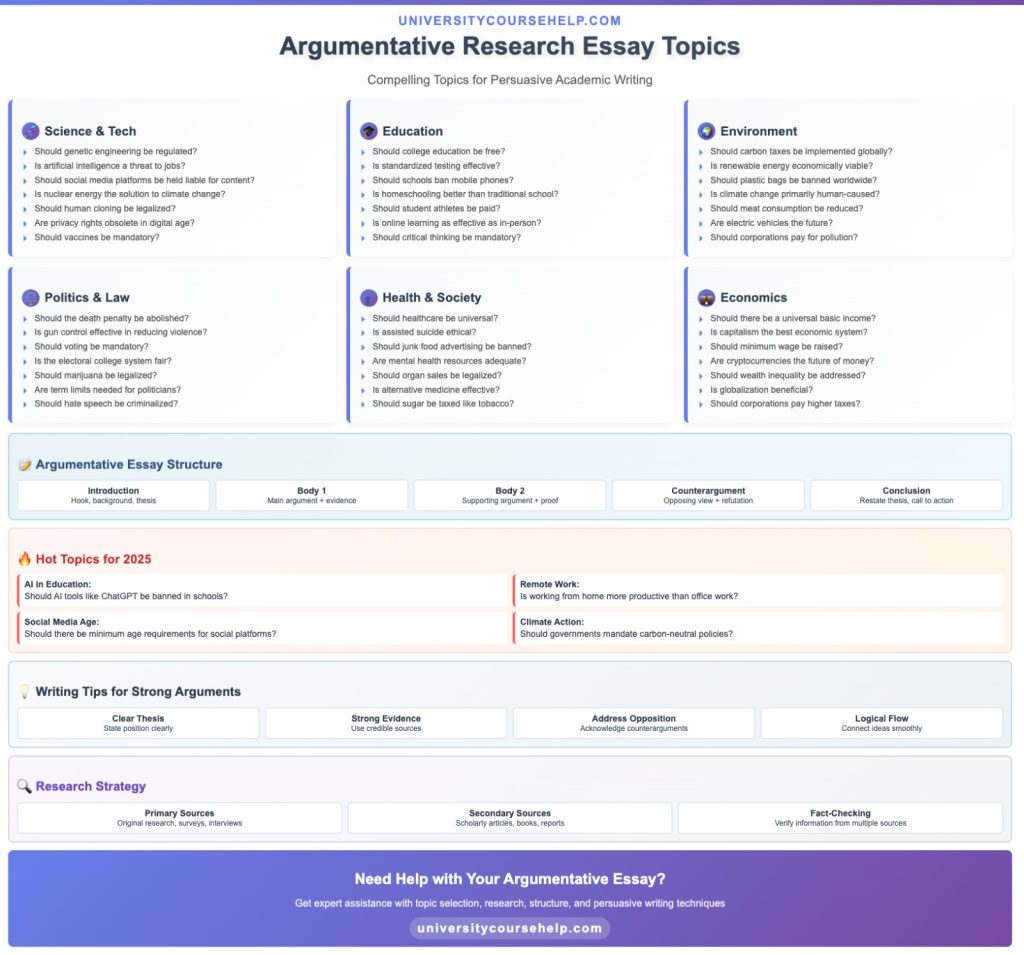
Here are some examples of strong argumentative essay topics across various categories, designed to spark your brainstorming process and help you get started:
1. Social Issues
- Should the government provide universal healthcare?
- Is social media harmful to teenagers’ mental health?
- Should same-sex marriage be legalized worldwide?
- Are affirmative action policies necessary to combat racial inequality?
2. Education
- Should college admission be based solely on academic performance or include other factors like extracurricular activities?
- Is online education as effective as traditional classroom learning?
- Should schools require uniforms for all students?
- Are standardized tests an accurate measure of a student’s abilities?
3. Politics
- Should voting be compulsory in all democracies?
- Is climate change the responsibility of individual governments or corporations?
- Should countries accept refugees fleeing from war-torn regions?
- Should marijuana be legalized for recreational use?
4. Technology
- Does the use of social media lead to the decline of face-to-face communication?
- Should artificial intelligence be regulated to prevent job displacement?
- Is the increased use of surveillance technology a violation of privacy rights?
- Are self-driving cars a threat to public safety?
5. Ethical Dilemmas
- Should animal testing be banned in the cosmetics industry?
- Is euthanasia morally acceptable?
- Should genetically modified foods be banned?
- Should the death penalty be abolished worldwide?
These argument essay topics cover a variety of topics that can spark rich discussions. When writing an argumentative essay, selecting one of these ideas can help ensure your paper is both relevant and compelling.
Best Argumentative Essay Topics for Students
If you’re a student looking for argumentative essay topics for students, it’s important to choose issues that are not only interesting but also feasible to research and write about. These topics should allow you to present your argument clearly while ensuring you can provide a summary of the opposing views and refute them effectively.
Here are some best argumentative essay topics for students:
- Should college students be required to take physical education classes?
- Is social media a positive or negative influence on youth?
- Should the voting age be lowered to 16?
- Is climate change the biggest threat to humanity today?
- Should school lunches be improved to include healthier options?
These strong argumentative essay topics for students can be tailored to specific academic fields, such as sociology, or broader societal concerns.
Topic Ideas to Help You Start Your Argument Essay
Selecting the right topic can help you avoid writer’s block and make the writing process smoother. Here’s a method to help you choose and pick a topic effectively:
- Brainstorm: Start by writing down any ideas that come to mind. Don’t worry about their feasibility or whether they’re perfect—just get your ideas on paper.
- Narrow down your list: Once you have several topic ideas, focus on the ones that allow you to argue for or against something, providing strong supporting evidence.
- Evaluate the topic’s strength: Check if your topic is controversial and whether there’s enough research material to back up your argument.
- Create a thesis statement: Your thesis should present your main argument and guide the entire essay. It’s essential to ensure your topic has a clear, debatable stance.
If you’re struggling to come up with a topic, consider looking at current events, social media debates, or academic journal articles for inspiration. Controversial issues are usually the best choice for argumentative essays because they provide ample debate.
Argumentative Essay Topic Ideas: Spark Your Creativity
Choosing a compelling argumentative essay topic is the first step in creating a persuasive paper. To get started, think about issues that resonate with you or have current relevance. These topics should allow you to argue for or against something with strong evidence. Brainstorm argumentative essay topic ideas by considering global or local issues, social trends, or even things you encounter in everyday life.
1. Social and Political Issues
- The impact of universal basic income on poverty alleviation.
- Should governments implement universal healthcare?
- The ethics of surveillance: Is privacy becoming obsolete?
- Should voting be compulsory in democratic nations?
- The role of social media in shaping public opinion and political discourse.
- The legality of euthanasia: Should it be legalized globally?
- The implications of income inequality on social mobility.
- The role of immigration in shaping modern societies.
- Should the government regulate the use of genetically modified organisms (GMOs)?
- The debate over climate change: Is human activity the leading cause?
- Is democracy under threat from populist movements?
- Should corporal punishment be banned in schools?
- The effectiveness of international sanctions as a political tool.
- Should countries with high carbon emissions be penalized financially for climate change?
- The legality and morality of prostitution: Should it be legalized worldwide?
- The rise of nationalism: A threat to global unity?
- Should governments intervene in the regulation of the internet?
- Can a nation be considered democratic if it doesn’t grant basic rights to all citizens?
- The role of technology in promoting political polarization.
- The impact of civil disobedience on democracy and governance.
2. Environmental and Sustainability Issues
- Is nuclear energy a sustainable solution for global energy needs?
- The ethics of animal testing in scientific research.
- Should governments take responsibility for the environmental impact of large corporations?
- Can environmentalism and industrialization coexist sustainably?
- The role of individuals in tackling climate change: Is personal responsibility enough?
- Should biodiversity preservation be prioritized over urban development?
- The consequences of deforestation on global ecosystems and climate change.
- The effectiveness of renewable energy policies in reducing global emissions.
- Should climate change deniers be banned from positions of influence in government?
- The role of corporations in promoting sustainability.
- Should plastic be banned to protect marine life?
- Is geoengineering a viable solution to combat climate change?
- The ethical implications of deep-sea mining for rare earth metals.
- Should urban agriculture be a primary focus in sustainable city planning?
- The role of environmental education in reducing ecological footprints.
Struggling to Find the Perfect Argumentative Research Essay Topic?
Don’t let topic selection hold you back! Whether you’re working on a college paper or a PhD dissertation, choosing the right topic is the first step toward writing a successful argumentative essay. Explore a wide range of argumentative research essay topics and discover one that sparks your interest.
3. Technology and Ethics
- Should artificial intelligence be regulated to prevent misuse in warfare?
- The ethical implications of gene editing technologies like CRISPR.
- The risks and benefits of self-driving cars: A new era of transportation?
- Should governments monitor and regulate social media content?
- The morality of artificial intelligence replacing human jobs.
- The impact of big data and analytics on consumer privacy.
- Is it ethical for companies to profit from personal data collection?
- Should there be a global regulatory body for AI development?
- The consequences of widespread surveillance: How much is too much?
- Are biometric security systems an invasion of privacy?
- The implications of AI-driven decision-making in healthcare.
- Should people be allowed to enhance their cognitive abilities using neural implants?
- The future of work: Should automation be embraced or restricted?
- Should autonomous weapons be banned in military conflicts?
- Should we create ethical guidelines for the development of robots with emotions?
4. Health and Medicine
- Should vaccines be mandatory for all citizens?
- The ethics of organ transplant allocation: Should there be a priority system?
- The role of government in regulating mental health care access.
- The debate over universal healthcare: Is it more effective than private healthcare?
- The use of performance-enhancing drugs in professional sports.
- The moral implications of cloning humans for medical purposes.
- Should alternative medicine be integrated into the medical mainstream?
- The benefits and risks of genetic testing for potential diseases.
- Should governments regulate unhealthy food consumption to combat obesity?
- The role of technology in modernizing healthcare delivery systems.
- Should mental health be treated with the same priority as physical health in healthcare systems?
- The use of animals in medical testing: Necessary or unethical?
- Should drug addiction be treated as a public health issue rather than a criminal one?
- The ethics of assisted suicide for terminally ill patients.
- Should public health policies be stricter to address the rise of lifestyle diseases?
5. Education and Society
- Should standardized testing be abolished in schools?
- The role of private education in promoting inequality.
- Should college education be free for all students?
- The impact of social media on students’ academic performance.
- The effectiveness of online education compared to traditional classroom learning.
- Should the government regulate homeschooling?
- Should universities focus more on job preparation than on intellectual growth?
- The importance of teaching financial literacy in schools.
- The role of education in shaping a more inclusive society.
- Should school curricula include teachings about controversial social issues like abortion and LGBT rights?
- Should schools implement a four-day school week to reduce stress and improve performance?
- The impact of bilingual education on cognitive development.
- Should physical education be mandatory for all students?
- The importance of creative subjects in a balanced education.
- Should universities be required to disclose salary data for graduates?
6. Ethics, Law, and Justice
- Should the death penalty be abolished globally?
- The morality of genetic screening: Should we test embryos for disabilities?
- Should same-sex marriage be legalized worldwide?
- The balance between national security and individual freedom: How much surveillance is too much?
- The ethics of punishing minors as adults in the justice system.
- Should hate speech be banned or protected under freedom of speech?
- The legality and morality of gun ownership.
- Should police officers be required to wear body cameras?
- The role of public defenders in ensuring justice for the underprivileged.
- The effectiveness of prison rehabilitation programs: Should we focus on reforming prisoners?
- Should civil disobedience be tolerated in democratic societies?
- The ethics of genetically modified organisms (GMOs) in food production.
- Should abortion be allowed in cases of rape and incest?
- The role of restorative justice in the criminal justice system.
- The moral implications of corporate lobbying in politics.
7. Cultural and Sociological Issues
- The role of media in shaping gender stereotypes.
- The ethics of cultural appropriation in the fashion industry.
- Is multiculturalism beneficial to modern societies?
- Should public spaces be regulated for the sake of maintaining societal norms?
- The impact of mass consumerism on global cultures.
- The influence of celebrity culture on societal values.
- Should the arts be funded by the government?
- The rise of nationalism and its effects on global cooperation.
- The role of feminism in modern society: How far has it come?
- Should hate crimes be punished more severely than other crimes?
- The debate over public monuments: Should controversial statues be removed?
- Should the government regulate how media portrays violence and crime?
- The role of religion in modern politics.
- The impact of technology on interpersonal relationships and communication.
- Should the voting age be lowered to 16?
8. Science and Technology
- The ethical implications of human cloning for reproductive purposes.
- Should space exploration be funded by taxpayers?
- The impact of artificial intelligence on the workforce and future employment.
- Should there be stricter regulations on genetically modified foods?
- Is it ethical to use stem cells for research and therapeutic purposes?
- The environmental impact of space travel: Should we limit exploration?
- Should artificial intelligence be granted the same legal rights as humans?
- The debate over fossil fuel energy vs. renewable energy sources.
- The ethics of brain-computer interface technology.
- Should scientists be allowed to genetically modify human embryos?
Make sure to cite reliable sources to back up your claims when researching. College transitions are a good area to explore, as students may have questions about how to navigate academic and social shifts. For example, “Should students be required to live on campus during their first year?” is a relevant and thought-provoking topic.
Prompt: How to Use Writing Prompts to Choose Your Argument
A prompt is a useful tool to help you focus your thinking and narrow down your topic. Writing prompts guide you toward a specific direction, making it easier to develop a thesis statement and organize your thoughts. Using a prompt can also prevent you from brainstorming endlessly without a clear focus.
For instance, you might be given the argument essay topic: “How should universities handle student mental health?” This prompt encourages you to explore arguments related to the availability of counseling services, the stigma surrounding mental health, and the responsibility of educational institutions. Be sure to cite studies, expert opinions, and real-world examples when discussing the issue.
Argument Essay Topics: Finding the Best Fit for Your Thesis
When selecting argument essay topics, focus on choosing a topic that has a controversial element, allowing you to present both sides of the argument. For example, the topic “Should the government impose stricter regulations on social media?” offers a controversial aspect with two clear opposing views: one advocating for regulation due to potential harm and the other arguing for free speech and personal responsibility.
In your argument essay, be sure to cite evidence from credible sources to support your argument. Consider how your topic might influence students making college transitions, especially in a digital world. Engaging with topics that impact students today can make your argument even more relevant and insightful.
Brainstorm: How to Generate Ideas for Your Argument Essay
Brainstorming is a crucial part of the writing process, especially when you’re searching for the perfect argument essay topic. Start by jotting down any ideas that come to mind without worrying about structure or complexity. Once you’ve generated a list, narrow it down to topics that are both controversial and support a clear argument.
Think about areas where college transitions may present challenges, such as adjusting to new academic expectations, social life, or the use of technology in learning. For example, “Are online classes as effective as in-person education?” is a topic that offers room for multiple perspectives. During the brainstorming phase, identify the sources you would use to cite your argument and the evidence needed to present both sides.
Controversial Topics: Selecting the Most Engaging Argument
To write an engaging argumentative essay, select controversial topics that spark strong emotions and divergent opinions. These topics will allow you to challenge conventional views, stimulate debate, and encourage readers to think critically.
For example, consider controversial issues such as the death penalty, climate change, or the ethics of genetic modification. For each topic, make sure to cite both sides of the argument to show a deep understanding of the subject matter. Such topics are especially powerful for students navigating college transitions, as they allow them to critically assess societal issues that directly affect their futures.
In conclusion, whether you’re starting your argumentative essay from a writing prompt, brainstorming a list of argument essay topics, or narrowing down your controversial subject, each step plays a vital role in crafting a persuasive argument. Remember to cite credible sources, and aim to create an essay that challenges your readers to think critically about important issues.
Writing an Argumentative Essay: How to Craft a Professional Essay
Writing an argumentative essay involves more than just choosing a topic—you must structure your paper in a way that clearly presents your argument while considering opposing viewpoints. Here’s how to craft a professional essay:
- Introduction: Start with a hook to grab the reader’s attention, followed by your thesis statement that presents your main argument.
- Body Paragraphs: Each paragraph should address a single point that supports your argument. Use credible sources and evidence to back up your claims.
- Counterarguments: Acknowledge and refute opposing views to show the strength of your argument.
- Conclusion: Summarize your main points and restate your thesis in a compelling way, urging the reader to consider your perspective.
Your goal is to persuade the reader, so ensure that each body paragraph clearly supports your thesis and is well-organized.
Final Thoughts
When selecting argumentative research essay topics, it’s important to choose a strong topic that offers room for debate and has sufficient resources to support your argument. Whether you’re focusing on societal, political, or educational issues, the best argumentative essay topics will allow you to explore multiple perspectives and showcase your critical thinking skills.
By following the steps outlined above, you can easily brainstorm and pick a topic that aligns with your interests and academic requirements. Remember, the right topic is the key to writing an argumentative essay that stands out!
Need help brainstorming or finding the perfect topic? Explore more ideas and examples at UniversityCourseHelp.com to kickstart your next great argumentative essay.
FAQs about Argumentative Research Essay Topics: Argumentative Essay Topics
1. What Are Some Good Topics for an Argumentative Research Paper?
When choosing argument paper topics, it’s important to select controversial topics that allow for a variety of perspectives. Topics that evoke strong opinions on both sides tend to work well for an argumentative essay. Consider topics to debate in areas such as politics, societal issues, science, or ethics. Here are a few strong argumentative essay topics to get you started:
- Abortion: Should abortion be legalized worldwide?
- Social Media: Does social media promote healthy communication or breed isolation?
- Climate Change: Is global warming caused by human activity?
- Animal Rights: Should animal testing be banned in the cosmetics industry?
- Gun Control: Do stricter gun laws reduce violence?
These argumentative essay topics for students are a great starting point, but you can also brainstorm and adjust based on your thesis or the perspective you wish to explore.
2. What Is a Good Argumentative Research Paper?
A good argumentative research paper presents a clear stance on a controversial issue and uses credible sources to back up its claims. It’s essential to provide supporting evidence for your argument and anticipate opposing viewpoints. A compelling argumentative essay doesn’t just present facts—it argues with purpose, persuading the reader to adopt your perspective or at least understand it.
Here’s how to craft a strong argumentative essay:
- Choose a strong topic: Pick an issue that has two sides to argue, and consider debating current events or societal issues.
- Create a clear thesis statement: Your thesis will be the main point of the paper. Make sure it’s persuasive and clearly lays out your argument.
- Organize your body paragraphs: Each paragraph should present one piece of evidence to support your thesis. Use credible sources and examples.
- Include counterarguments: Address opposing views to show you’ve considered different perspectives and can support your thesis effectively.
3. What Is an Example of a Topic of an Argumentative Essay?
Here’s an example of an argument essay topic: Should college education be free for everyone?
This is an issue that allows for multiple perspectives, including those who argue that higher education should be a public good and those who believe individuals should pay for it. Your thesis statement might argue that free education promotes equal opportunity, supported by credible sources. A strong argumentative essay on this topic would:
- Examine societal and financial impacts.
- Discuss the long-term benefits and challenges.
- Address opposing viewpoints regarding funding.
4. How to Pick a Topic for an Argumentative Essay?
When you’re ready to pick a topic for an argumentative essay, there are a few strategies you can use:
- Brainstorm ideas: Think about current controversial topics or recent events that interest you. This helps to generate argumentative essay topic ideas.
- Consider your perspective: A good argumentative essay requires you to take a stance. Pick a topic that resonates with your beliefs, but be open to understanding the opposing viewpoints.
- Choose a manageable topic: Don’t pick something too broad or too obscure. A tricky subject might make writing difficult, while a straightforward topic will be easier to address within the paper’s constraints.
- Use a debate prompt: Think of a topic that can easily be debated, such as “Should the voting age be lowered?” or “Is climate change a natural phenomenon or caused by human activity?” This ensures you have two sides to argue effectively.
When brainstorming, try to choose a topic that fits your assignment and writing argumentative essays guidelines. You’ll want a comprehensive topic with enough credible sources to back your argument and avoid writer’s block.
By following these strategies, you can find a topic that not only fits your assignment but also allows you to showcase your critical thinking skills. Don’t forget to organize your paper by crafting a clear outline and summarizing key points in each paragraph, ensuring your argument is persuasive and well-structured.

