

Sample MLA Research Paper: A Comprehensive Guide to Formatting and Examples
When it comes to academic writing, ensuring that your research paper adheres to the right formatting standards is crucial. Among the most widely used formatting styles is MLA (Modern Language Association), which is frequently employed in the humanities. If you’re preparing your next research paper, using a sample MLA research paper can be incredibly helpful to ensure you meet the required guidelines.
This blog post will explore the components of an MLA research paper, provide a sample paper for reference, and guide you through the essential sections of your document. Whether you are working on an essay, thesis, or any other academic project, understanding how to write MLA format will help you present your work in a professional and standardized way.
Sample Paper: Understanding the Structure and Elements
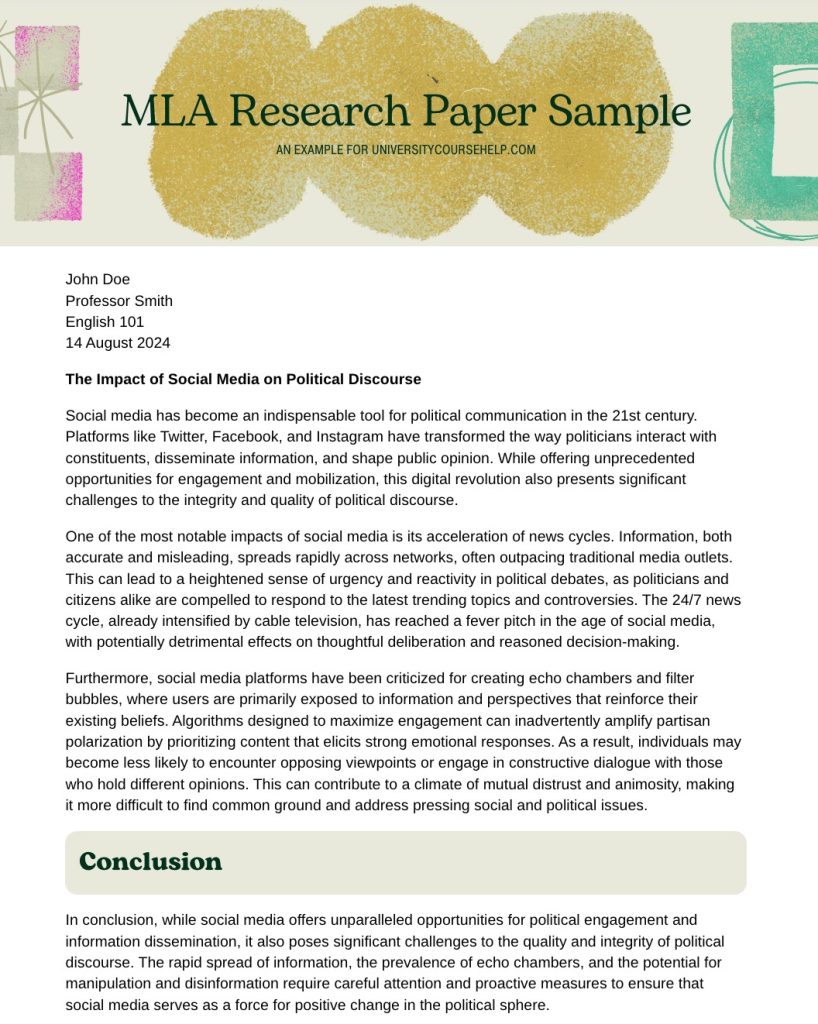
A sample paper serves as a visual reference for students looking to understand the structure and formatting required in MLA style. It demonstrates how the title page, headings, citations, and other key sections of the paper should be formatted.
In a sample MLA paper, the following sections are typically included:
- Title Page: MLA generally does not require a cover page unless specified by the instructor. The first page will feature the title of your paper, your name, instructor’s name, course title, and date, all aligned to the left.
- Body: The body of the paper will contain the introduction, main arguments, and conclusion. Every paragraph is indented by 0.5 inches, and the text is double-spaced. The first line of each paragraph should also be indented.
- Works Cited Page: At the end of the paper, a Works Cited page lists all sources referenced in the research. This page should be formatted with a hanging indent, where the second and subsequent lines of each citation are indented by 0.5 inches.
Referencing a sample MLA paper can help you understand how to apply MLA formatting correctly. For instance, instead of manually writing citations, you can follow the MLA sample paper as an example of how to cite different types of sources—books, articles, websites, and more.
Works Cited: Proper Citation in MLA Format
The Works Cited page is a crucial section in any MLA research paper. It lists all the sources you have referenced throughout your paper. Every source must be cited following specific MLA guidelines to avoid plagiarism and ensure academic integrity.
For example:
Book Citation:
Last Name, First Name. Title of Book. Publisher, Year of Publication.
Article Citation:
Last Name, First Name. “Title of Article.” Title of Journal, vol. number, no. number, year, pages.
When creating a Works Cited page, ensure that the list is organized alphabetically by the author’s last name. This is essential for consistency and proper referencing.
MLA Sample Paper: Visualizing MLA Formatting
If you’re unfamiliar with the MLA style, a MLA sample paper can act as a guide to understanding proper formatting. A sample MLA paper typically includes:
- Proper header: Your last name and page number appear in the top right corner on each page.
- Title: The title of your paper is centered on the page without any bolding, italics, or underlining.
- Citations: In-text citations are placed in parentheses after the quoted or paraphrased information, typically including the author’s last name and the page number.
- Works Cited: A complete list of all the references used in your research, formatted correctly according to MLA guidelines.
You can access a sample MLA paper through resources like the library at Los Angeles or other educational websites that provide examples of correctly formatted papers.
List: Key Elements of an MLA Research Paper
Here’s a quick list of the essential components of an MLA research paper:
- Title Page (if required)
- Introduction (including your thesis statement)
- Body (organized into sections with headings, if necessary)
- Conclusion (summarizing your findings)
- Works Cited page (listing all your sources)
Each section serves a specific purpose in the paper and should be formatted according to MLA standards. By referencing a sample MLA paper, you can better visualize how to format each section.
Page: Understanding MLA Format in Detail
Each page of your research paper must adhere to specific MLA formatting rules to maintain consistency and professionalism. For example, the header should contain your last name and the page number aligned to the right margin. The page is brought to life with clean, readable text formatted according to MLA standards. It is also important to note that MLA format should be short, concise, and easy to follow—ensuring the content is presented clearly without unnecessary complexity.
Each section should start on a new page if it is long enough to warrant one, and in cases where chapter divisions are present, these should be clearly indicated with appropriate headings or subheadings.
Rights Reserved: The Importance of Original Work
When working with MLA formatting, it’s crucial to use quotation marks around any direct quotes or ideas that are not your own. This ensures you’re properly attributing the source and protecting the rights reserved to the original author. Proper citation is essential, as failing to do so could result in plagiarism or other academic integrity issues.
As the site constitutes acceptance of these rules, always be mindful of how you incorporate material into your work. Anything you reproduce or broadcast from a published source must be cited, and it’s important to avoid redistributing without permission the content of works you do not have the right to use.
Edition: Referring to the Right Publication
When citing a source, always include the correct edition of the work. For example, if you are referencing a book, make sure to note whether it’s the first edition or a later edition. If the text has undergone significant changes, this distinction is crucial. Citing the wrong edition could lead to confusion about the accuracy of the information being referenced.
Using MLA Style Correctly: Short Examples and Long Explanations
In MLA style, it’s essential to italicize the titles of long works such as books, movies, or journals. For instance, a book title like The Great Gatsby should be italicized, while shorter works like articles or essays should be enclosed in quotation marks.
Additionally, in-text citations should be clear and concise. If you’re providing a short quote, use quotation marks to indicate the borrowed material and reference the source appropriately. If the quote is long, over four lines, format it as a block quote, and make sure it’s properly indented from the rest of the text.
Rewrite and Reproduce: Ensuring Accurate Citations
When you rewrite or paraphrase someone else’s ideas, make sure to cite the source. Even when rewording someone else’s work, the original source must be acknowledged. This ensures that you do not reproduce another author’s thoughts without giving proper credit.
If you’re unsure about whether something should be rewritten or quoted directly, the general rule is simple: short ideas and phrases should be paraphrased and cited, while long passages that are directly quoted must be formatted with quotation marks and followed by an in-text citation.
Example: Demonstrating Correct MLA Formatting
Here’s an example of how to cite a book using MLA format:
Book Citation Example:
Smith, John. Introduction to Philosophy. 2nd ed., Harper & Row, 2020.
Notice how the edition is included after the title and italicized. This helps readers identify which version of the book you referenced.
If you are quoting from a chapter within an edited collection, the format would slightly change. Here’s how it might look:
Chapter Citation Example:
Jones, Sarah. “Ethics in the Modern World.” Philosophical Issues, edited by Robert Brown, 3rd ed., Harper & Row, 2021, pp. 45-67.
In this case, the chapter title is placed in quotation marks, while the book title is italicized, and page numbers are provided at the end.
Conclusion: How to Use MLA Style to Create an Outstanding Paper
Following the MLA style properly helps you create an organized, readable, and professional paper. Whether you are referencing short quotes or long passages, knowing when to italicize and use quotation marks is crucial. Be sure to rewrite or reproduce information accurately, providing proper in-text citations and a Works Cited page.
By utilizing MLA formatting examples and referring to resources like the Purdue OWL®, you can ensure that your citations are accurate, your formatting is consistent, and your paper adheres to all academic standards.
Finally, remember that your site constitutes acceptance of MLA guidelines. Whether you’re using a sample MLA paper or working through your own, this adherence is necessary to produce quality academic writing. Keep in mind that the work you broadcast, rewrite, or reproduce must be original or properly cited, ensuring respect for the authors’ rights reserved.
Section: Organizing Your Paper with MLA Guidelines
The section of your paper determines how your content is organized and presented. MLA style doesn’t require a formal outline, but each part of your paper should follow a logical structure:
- Introduction: Begin with an introduction that provides background information and presents the thesis.
- Body: The body paragraphs should each cover a distinct aspect of your argument. Ensure that each paragraph begins with a clear topic sentence.
- Conclusion: End with a conclusion that ties your points together and reiterates your thesis, without introducing new information.
Remember that MLA format requires consistent use of double-spacing, 12-point font size, and Times New Roman. Each paragraph should also be indented by 0.5 inches.
Need a Template for Your MLA Research Paper?
Learn the secrets to perfect MLA formatting with our Sample MLA Research Paper! Whether you’re writing your first paper or preparing for a PhD-level thesis, our sample gives you the structure, citations, and formatting guidance you need to succeed.
Final Note: How to Use a Sample MLA Paper for Success
When writing your MLA research paper, refer to a sample paper to better understand how to structure your work. Whether you’re drafting an outline, building your introduction, or creating citations, these samples can be incredibly beneficial.
You can access many examples online—simply click on a MLA sample paper for a detailed, professional format. Some educational websites also offer downloadable resources for printing this page, which can help you work more efficiently.
For additional help, be sure to consult MLA formatting examples available through your school’s writing center or trusted academic resources like the Purdue OWL®. These sites often offer step-by-step guides, sample MLA paper templates, and works cited instructions to guide you through the process.
In conclusion, mastering MLA format will elevate your academic writing and ensure your paper adheres to the standards of professional scholarship. Use sample MLA research papers as your reference, and follow the rules laid out in the MLA handbook to ensure clarity and consistency throughout your work.
If you’re still unsure about the MLA guidelines or need further assistance, feel free to explore more examples or get help from experts who can guide you through the process of formatting your paper.
FAQs about Sample MLA Research Paper: College Library MLA Citation Format
1. How to Write an MLA Style Research Paper?
Writing a research paper in MLA style involves several steps. Here’s a guide to help you through the process:
- Title and Heading: The MLA format cover page is optional, but if you are including one, it should contain the title of your paper, your name, the instructor’s name, the course, and the date. Most commonly, the MLA format front page consists of just your title, name, instructor, and date—centered on the first page.
- In-Text Citations: Throughout your paper, make sure to include in-text citations following MLA style guidelines. These citations refer to the source material used in your document. Typically, these are formatted with the author’s last name and the page number in parentheses.
- Works Cited Page: At the end of your research paper, create a Works Cited page where you’ll list all your sources in alphabetical order. Each source should include information such as the author’s name, title of the book or article, and publication details.
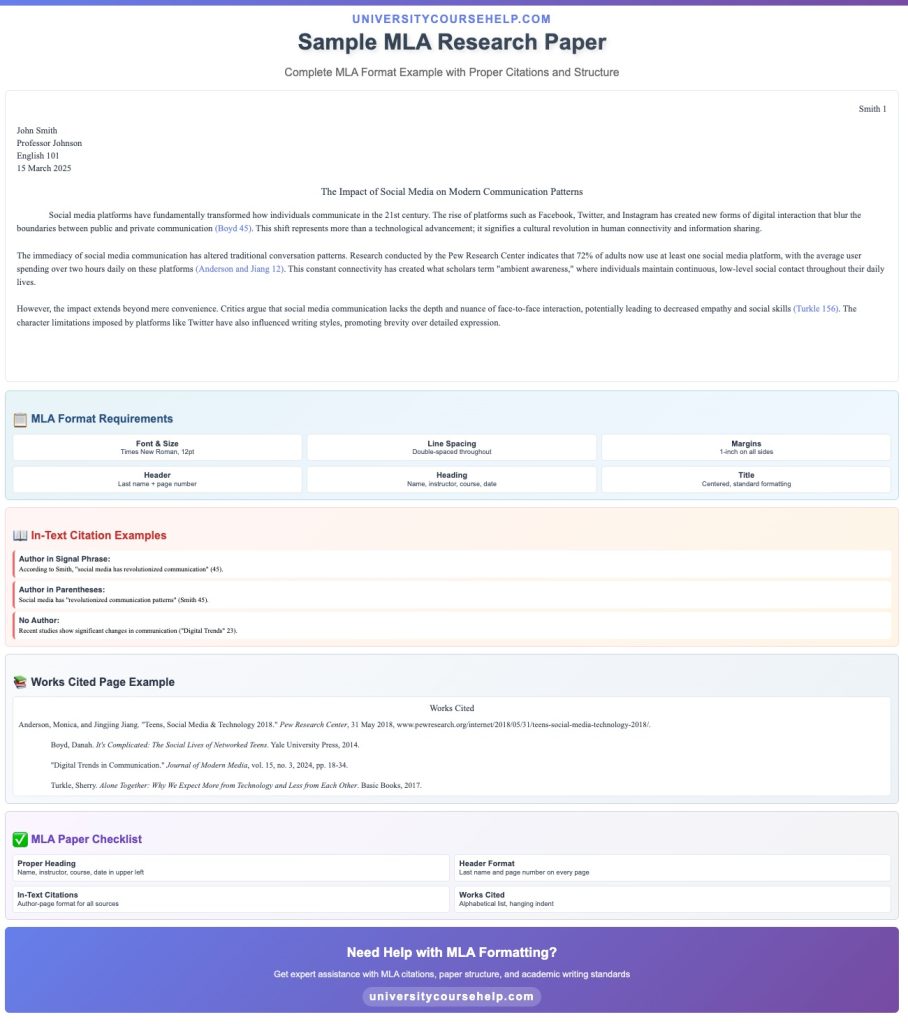
- Formatting: Use 12-point font size, preferably Times New Roman or another legible font. All margins should be set to 1 inch, and the entire document should be double-spaced. Ensure your text is aligned to the left margin and you use the proper indentation.
By following this MLA formatting example, you’ll be able to produce a well-structured research paper.
2. What is an Example of MLA Format in Research?
An example of MLA format in a research paper typically looks like this:
- Title: Centered on the first page
- First Line of Each Paragraph: Indented by 0.5 inches
- In-Text Citations: Example: (Smith 123) where 123 is the page number from the book or article.
- Works Cited Page: A properly formatted Works Cited page should list all the sources you’ve used in your research, following MLA citation rules.
For a complete sample paper, you can check the Purdue OWL® website, which offers detailed instructions and a sample MLA paper for reference.
3. How to Write an MLA Research Paper Outline?
To create an outline for your MLA style research paper, follow these steps:
- Title Page: If required, ensure that your MLA format cover page includes all necessary details.
- Introduction: The introduction should provide context for your research and introduce the thesis statement.
- Body Sections: Each section of your paper should represent a major argument or point related to your topic. Be sure to indent the first line of each paragraph.
- Conclusion: Summarize the findings of your research and reinforce the thesis.
For each of these sections, you should provide proper citations and ensure the format adheres to MLA style guidelines. You can check an MLA format essay example for further clarity.
4. What is the Correct Format for an MLA Paper?
The correct format for an MLA paper includes the following essential elements:
- Font and Margins: Use a readable font such as Times New Roman in 12-point size. Set all margins to 1 inch.
- Spacing and Indentation: Your entire paper should be double-spaced, with the first line of each paragraph indented 0.5 inches.
- Title and Page Numbering: Your title should be centered on the first page, and each subsequent page should have a page number in the top right corner, including your last name.
- Works Cited: At the end of the paper, include a Works Cited page, listing all the sources you referred to. Each entry should follow MLA citation style guidelines.
You can refer to the following sample paper or visit the Purdue OWL® site to see a detailed MLA style research paper example, as well as how to format a Works Cited page.
In all instances, remember that MLA formatting is a tool to ensure your work is legible and professional. Following the MLA style research paper guidelines ensures that your sources are correctly attributed and your paper has the right structure.

