

Research Questions Examples: Defining and Formulating Effective Research Questions

When embarking on a research project, one of the crucial steps is formulating research questions. These questions guide the direction of the study and influence the research design. Whether you’re conducting a qualitative or quantitative study, well-crafted research questions help to shape your investigation and ensure it is both focused and effective. Below, we’ll explore different types of research questions with examples and discuss how to formulate questions that drive successful research.
What is a Research Question?
A research question is a specific inquiry that a researcher aims to answer through systematic investigation. It defines the focus of your research project and determines the type of research methodology to use. Whether qualitative or quantitative, research questions are central to gathering relevant data and drawing valid conclusions.
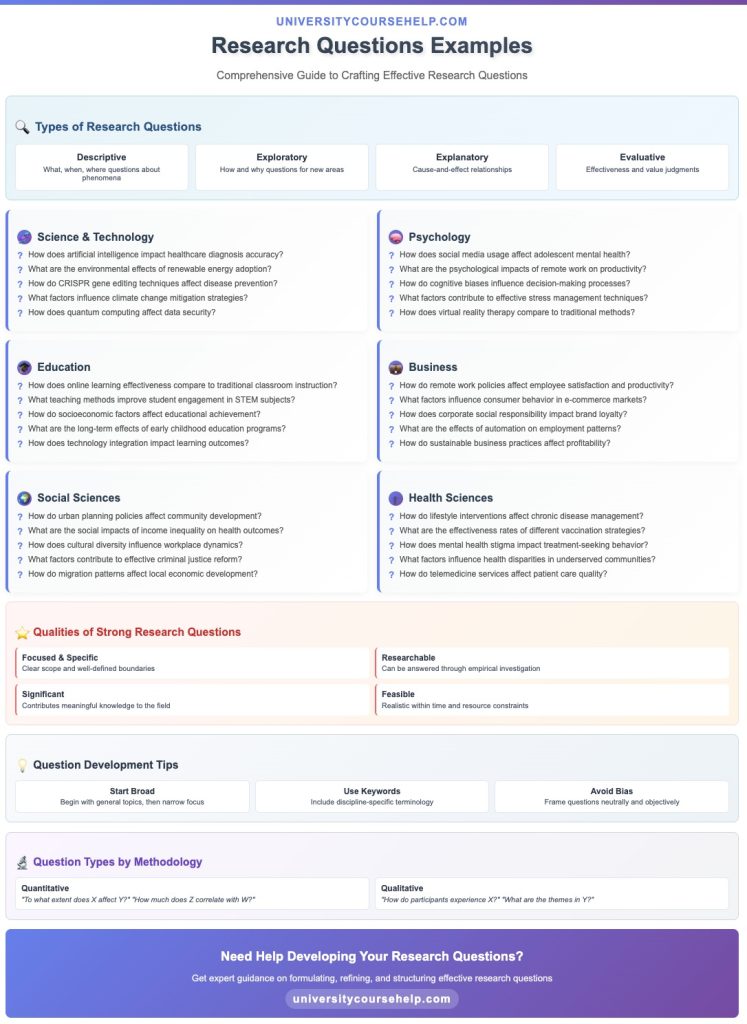
A good research question should be:
- Clear and specific: It should be concise and easily understandable.
- Focused and actionable: A research question should focus on one specific area and be answerable with available research methods.
- Researchable: There should be enough resources and data available to answer the question.
- Feasible: The question should be capable of being researched within the given time frame and resources.
Types of Research Questions: Quantitative and Qualitative
Research questions can be divided into two broad categories: quantitative and qualitative. Each category serves a distinct purpose and follows different research methods and processes.
Quantitative Research Questions
Quantitative research questions seek to investigate numerical data, trends, and relationships. These questions are usually associated with hypotheses and are tested through experiments or statistical analysis. Quantitative research focuses on measuring variables and analyzing patterns in the data.
Examples of quantitative research questions:
- How does increasing telecommuting trends affect employee productivity in different sectors?
- What is the impact of digital marketing strategies on consumer purchasing decisions over the next 10 years?
- To what extent do 3D animations in educational platforms enhance user engagement compared to 2D animations?
These types of questions typically involve cause-and-effect relationships and can be answered using statistical tools to analyze variables and test the significance of the results.
Qualitative Research Questions
Qualitative research questions, on the other hand, focus on exploring experiences, perceptions, and opinions rather than numerical data. These questions are generally more open-ended and are aimed at gaining a deeper understanding of complex phenomena. Qualitative questions often explore the “why” and “how” behind issues, rather than just measuring them.
Examples of qualitative research questions:
- How do video games enhance immersion in players, and what elements contribute to a more engaging experience?
- How do young adults perceive digital content when targeted with personalized advertising techniques?
- What are the challenges and opportunities in adapting urban planning strategies to accommodate reduced daily commutes?
These questions are often explored through interviews, focus groups, and content analysis, allowing researchers to draw insights from non-numerical data.
Formulating Well-Crafted Research Questions
A well-crafted research question forms the foundation of a strong research project. To formulate an effective question, it’s essential to first identify your research topic and purpose. Here are a few tips for creating effective research questions:
- Focus on Specific Aspects: Instead of asking broad questions like “What are social issues?”, narrow it down to more specific questions such as “How do social media platforms contribute to the rise of mental health issues among teenagers?”
- Consider the Type of Question: Decide whether your research question will be qualitative or quantitative, depending on the focus of your study. This will influence the research design and data collection methods you use.
- Formulate a Clear and Concise Question: Avoid vague or ambiguous wording. A good research question should clearly define what you are investigating and what you hope to achieve.
- Ensure Feasibility: Make sure your research question is something that can be answered within the scope of your study, given the resources available.
- Evaluate Your Question: A strong research question should guide your research and contribute new insights to the field. Ensure that it is not too broad, nor too narrow. It should also align with your research objectives.
Research Question Examples Across Various Disciplines
Research questions can vary greatly depending on the field of study. Here are a few examples of research questions from different disciplines:
Sociology
- How do social concerns like economic inequality impact voting behavior in the U.S. during national elections?
- What are the implications of racial inequality in the criminal justice system?
Business & Marketing
- How do personalized marketing strategies affect consumer buying decisions in the digital age?
- What is the relationship between work-life balance policies and employee productivity in technology companies?
Education
- What are the effects of online learning on student engagement and academic performance in high school?
- How do active learning strategies in STEM classrooms impact student retention rates?
Health and Psychology
- How can mental health treatments be improved with the integration of virtual therapy sessions?
- What is the impact of telehealth on access to healthcare in rural communities?
Research Methods and Crafting Effective Research Questions
In any dissertation or research project, selecting the right research methods to address your research questions is crucial. Different research questions will require different approaches, depending on whether you are conducting quantitative or qualitative research. Understanding the research methods available allows you to determine the best approach for answering your research question and ensuring the validity of your findings.
Quantitative Research Questions Examples
Quantitative research questions seek to explore relationships between variables and use statistical methods to analyze and quantify data. These types of questions often focus on determining patterns, correlations, or causal relationships between one or more variables.
Examples of quantitative research questions:
- How do increasing telecommuting trends impact productivity in different industries over the next 20 years?
- What is the effect of print versus digital designs on consumer engagement levels for a young adult audience?
- To what extent does video game design (e.g., 3D vs 2D graphics) influence user immersion in educational platforms?
These types of questions will often require statistical analysis, where the relationship between variables is explored, and patterns can be drawn to make predictions or inform decisions.
Comparative Questions in Research
A comparative research question aims to explore differences between groups, variables, or concepts in a systematic way. These questions are often focused on comparing the outcomes, behaviors, or characteristics of different groups, such as comparing two types of products or contrasting the effects of two educational techniques.
Example of a comparative research question:
- What are the differences between groups who use traditional teaching methods and those who use immersive, video-based learning tools in terms of academic performance?
These types of questions are particularly useful when the researcher wants to explore how variables or practices compare against each other, shedding light on trends or outcomes that may inform the field.
Relationship-Based Questions
Relationship-based questions focus on how different variables or phenomena are linked together. In research, understanding the relationship between variables can help to explain causal mechanisms or identify potential correlations that are useful for deeper insights.
Examples of relationship-based research questions:
- How does the design of educational video games impact student engagement levels and learning outcomes?
- What is the relationship between user experience design and the level of immersion in digital media such as virtual reality games?
Relationship-based questions allow researchers to analyze the interactions between variables, providing deeper insights into how different elements in a study might influence each other.
Specific Research Questions: A Focus on One Variable
One key aspect of a specific research question is its ability to focus on one variable at a time. A question that is too broad or not focused enough can lead to poor or inconclusive results. A well-crafted research question should focus on one key variable and explore how it is measured, impacted, or influenced by other factors.
Example of a specific research question focusing on one variable:
- How does user engagement with mobile apps in educational settings influence learning outcomes in K-12 students?
By focusing on one variable, the researcher can provide a more accurate and clear focus that can be answered using quantitative methods and measured by data collection tools.
Developing Research Questions Across Various Disciplines
Research questions are unique to each field of study and discipline. In sociology, questions may explore societal issues, while in digital marketing, questions may delve into consumer behavior. Regardless of the area of study, a research question should be crafted with careful consideration to ensure that it is specific, focused, and actionable.
Examples of research questions across various disciplines:
- Sociology: How do social networks influence political participation among young adults?
- Marketing: What are the consumer behavior trends for mobile shopping in the next decade?
- Urban Planning: How can urban areas adjust to the reduced daily commutes and increased remote work?
These questions reflect the diversity of research ideas across various disciplines. Whether the topic is about digital marketing trends, social behavior, or urban planning strategies, crafting a focused research question is essential for guiding the entire research process.
Looking for inspiration to craft the perfect research question for your project?
Explore our extensive collection of research question examples at UniversityCourseHelp.com and start developing a focused, impactful research topic today! Whether you’re working on a qualitative or quantitative project, we have the resources and guidance to help you succeed. Start your research journey now!
Uncovering Key Insights and Setting the Stage for Your Research Dissertation
A well-crafted research question not only provides a clear focus for your research but also sets the stage for uncovering key insights that can contribute to academic discourse. It serves as the foundation upon which the research paper or dissertation is built, directing data collection, analysis, and ultimately leading to conclusions that are both impactful and relevant.
By uncovering important trends or by focusing on new angles within your field of study, you can ensure that your research adds value to the ongoing conversations and offers innovative solutions or new perspectives.
Examples of questions that help to set the stage for future research:
- How can digital marketing strategies evolve over the next 20 years to respond to changing consumer behaviors?
- What are the new trends in video game design that will enhance user experience and engagement in educational games over the next half-century?
Concluding Thoughts
Crafting effective research questions is an essential part of the research process. Whether for a dissertation, thesis, or research paper, a well-formulated research question provides a clear focus that guides the direction of the research, determines the methodology used, and shapes the outcomes of the project. Whether your research is quantitative or qualitative, a strong research question sets the foundation for meaningful exploration and contributes to the advancement of knowledge in your field.
If you are ready to begin formulating your research questions for your next project, UniversityCourseHelp.com can help you with expert guidance and professional support for your academic writing.
How to Formulate Focused and Specific Research Questions
In the process of writing a research paper, the first and most crucial step is to formulate a research question. A research question that is not focused enough can lead to vague, unfocused, and weak results. It’s essential to ensure that the question is specific and clearly defines the scope and purpose of the study. This also helps to narrow the range of research and guide the direction of the study.
Look at some examples of focused and well-crafted research questions:
- How will increasing telecommuting trends affect the productivity of workers in different industries over the next two decades?
- In what ways do print and digital designs differ in terms of consumer engagement when targeting a young adult audience?
The Importance of Specific Research Questions
A question is specific when it identifies the key focus of the study and outlines the specific variables involved. When writing your research paper, it’s crucial to make sure that the research question you choose is specific enough to guide the research effectively.
For example:
- What elements and principles should be considered when targeting a young adult audience with print versus digital media?
- How does sound design enhance immersion and impact the effectiveness of video games in engaging players compared to other types of digital media?
By defining a specific question, you reduce the risk of vague conclusions and increase the relevance of your findings. It’s easier to collect data and perform data analysis when your question is clear and precise.
Exploring the Scope of Research Questions
The range of research can be vast, especially when dealing with topics such as global digitalization or video game design. To prevent your research from becoming too broad, try to narrow down the scope of your question to focus on a specific aspect of the larger topic.
For example, you could ask:
- How do designs in video games enhance immersion more effectively when compared to print advertisements in a digital age where global digitalization plays a key role?
- What are the key materials used in sound design that evolve to improve the overall experience of immersion in video games?
By considering the broader topic but narrowing it to something specific, you avoid a question that’s too general or too difficult to tackle.
Questions for the Future: Exploring Long-Term Trends
One of the strengths of crafting a good research question is its ability to anticipate future trends. For instance, you may want to explore how a specific trend will evolve over a period of time, such as:
- How will increasing telecommuting trends continue to affect work productivity across industries over the next two decades?
- What are the implications of global digitalization on the material selection and design elements in the next 20 years?
This type of question provides the foundation for exploring the long-term implications of current trends. The findings could provide insight into how industries or practices may change in response to emerging technologies or societal shifts.
Evaluating Game Design: Impact of Immersion on Engagement
Video games are an example of a design field where specific questions can lead to highly interesting and valuable research. A question is specific when it addresses a key issue within the context of game design and player engagement.
For example:
- How does sound design enhance immersion in video games? What specific aspects of sound design contribute to player engagement and how do they compare to traditional forms of media?
- Do video games with more immersive sound design engage users more effectively than other games with less emphasis on auditory elements?
These types of research questions delve into the design choices that enhance the user experience and can lead to insights on how to improve player immersion in digital media.
Understanding the Impact of Digital Design on User Engagement
As digital design evolves, especially in media targeting younger audiences, it becomes essential to understand the changes in material and content selection:
- How do elements and principles of design evolve when targeting a young adult audience, especially in the digital space?
- How does the evolution of material selection impact the success of digital designs in attracting and retaining the attention of younger demographics?
These types of questions help researchers understand how design choices affect audience engagement, leading to insights on how to better target younger, tech-savvy consumers.
When writing a research paper, having a clear and specific research question is essential. A research question that is not focused enough can easily lead to unclear or irrelevant results, while a specific question allows you to explore the topic thoroughly and gain deeper insights. By focusing on specific trends such as telecommuting, sound design, or digital design, you can narrow your scope and explore areas that lead to meaningful conclusions. In addition, addressing future trends or examining design choices within the context of the digital world helps to frame the research in a way that adds to the ongoing academic discourse and provides actionable insights for the future.
The Importance of Well-Formulated Research Questions in Academic Research
The research question is the starting point for any academic research project. It shapes the direction of the study and determines the research methods to be used. Whether you are writing a dissertation or a research paper, a clear and focused research question allows you to stay on track, ensures the relevance of your findings, and helps you avoid research problems that could lead to inefficiencies.
By addressing significant issues and focusing on research questions that can be tested and answered through appropriate research methods, you can enhance your research and contribute valuable insights to your field. For instance, exploring a question like “What is the role of user engagement in the effectiveness of educational video games?” allows for qualitative analysis of game design principles and user interaction, leading to a better understanding of both fields.
Conclusion: Crafting Effective Research Questions
Whether for your dissertation, research paper, or thesis, the key to a successful project lies in how well you formulate your research questions. By focusing on specific, actionable questions within your chosen field of study, you can ensure that your research process is efficient, effective, and meaningful. A strong research question not only guides the research design but also helps to focus your analysis and enhance the outcomes of your research project.
If you need assistance with formulating strong research questions for your academic research, consider reaching out to UniversityCourseHelp.com for professional writing guidance and support.
FAQs about Good Research Questions Examples to Guide Your Research
What Are 5 Good Research Questions?
- How does telecommuting affect work-life balance in different industries?
- This research question explores the relationship between remote work and personal life, offering opportunities to study work patterns, productivity, and mental health. It’s an example of a quantitative research question that can be tested using data collection from surveys, interviews, and statistical analysis.
- What are the environmental impacts of increasing global demand for timber?
- This comparative research question examines the impact of rising timber demand on deforestation and ecosystem degradation. It allows the researcher to investigate both qualitative and quantitative factors, making it suitable for various research methods.
- How do different urban planning strategies adjust to potentially reduced daily commutes?
- This qualitative research question focuses on examining the socio-economic and environmental effects of changing work habits, particularly how cities will adapt to future commuting trends. The research process would likely involve interviews, observations, and qualitative data collection.
- In what ways do traditional painting techniques, such as oil and watercolor, differ in terms of aesthetic value?
- A question focusing on artistic comparison, this could delve into qualitative research involving dissertation research with visual analysis, expert interviews, and audience perception studies to evaluate the artistic and cultural impact of different mediums.
- What are the key challenges and opportunities that companies face when implementing digital marketing strategies targeting young adults?
- This research question, aimed at digital marketing, could explore the effectiveness of different strategies for engaging a younger demographic. The research would use both qualitative and quantitative methods, such as surveys, focus groups, and data analytics to examine trends.
What Are Some Good Questions to Research?
Good research questions are those that are focused, actionable, and specific enough to guide your research process. Here are some examples:
- How do various social concerns, such as racial equality and economic inequality, impact the decision-making process in political elections?
- What role do user engagement levels differ between 2D and 3D animations in educational platforms?
- How does the increasing global demand for timber impact forest conservation efforts?
These examples of research questions offer a clear focus and are well-crafted to ensure that they address a research problem and allow for data collection.
What Is One Example of a Research Question?
An example of a specific research question could be:
- How do web design trends influence user engagement across various digital platforms?
- This quantitative research question looks at the relationship between design elements and user interaction. The research methodology might involve experimental research where designers test different design principles across multiple platforms, gathering quantitative data on user engagement.
What Are Basic Research Questions?
Basic research questions often aim to understand fundamental principles and processes. These questions help establish the framework for further investigation. Some basic research questions are:
- What are the key differences between oil and watercolor painting techniques in terms of texture, color application, and perception?
- How does the increase in telecommuting trends affect urban transportation systems?
- These research questions are broad enough to explore numerous aspects but can also be narrowed down for specific studies. Preliminary research can help refine them to a more focused research question, enhancing the overall research objectives.
Remember, a strong research question should be actionable and specific enough to guide you throughout your research paper writing process. Whether you choose quantitative or qualitative research, your research question should always help you uncover new insights and synthesize findings that contribute to your field of study.

